Views: 0 Author: Site Editor Publish Time: 2026-10-14 Origin: Site
Grid instability and rising diesel expenses make off-grid exterior lighting an absolute necessity across Nigeria. Securing private estates, university campuses, business premises, and public roads requires reliable illumination. Facility managers and homeowners need lighting solutions that function independently of the national grid. However, buyers face a highly fragmented market characterized by extreme variance in quality and performance. Units heavily promoted on social media often boast massive specifications, creating confusion when comparing them against professional-grade fixtures.
The core challenge lies in distinguishing between durable, high-performance units and counterfeit imports with exaggerated capabilities. A solar street light must withstand harsh weather, intense heat, and heavy dust. This guide provides an evidence-based breakdown of the current market landscape in Nigeria. We will explore the technical components that dictate upfront investments and provide a framework for evaluating long-term lifecycle value over immediate savings.
Baseline Pricing: Residential-grade solar street lights typically start at entry-level rates, while commercial and highway-grade systems require higher investments depending on true lumen output and battery capacity.
The Wattage Trap: Many low-cost units advertise impossible wattages (e.g., "150W to 4000W"). Procurement decisions must be based on battery chemistry (LiFePO4), panel type, and actual lumen output rather than printed wattage.
System Architecture: Buyers must choose between All-in-One (integrated) systems for ease of installation and Split systems for higher performance and longevity in demanding environments.
Lifecycle Value: Cheaper units often rely on inferior lead-acid or low-grade lithium batteries that fail within 6–12 months. Factoring in ongoing maintenance, panel cleaning, and replacement services makes premium units with 3-to-5-year lifespans significantly cheaper long-term.
Table of Contents
Solar street lights in Nigeria are often marketed with wattage labels such as 200W, 400W, or 800W, but advertised figures may not represent actual LED power consumption. Buyers should compare verified LED wattage, lumen output, solar panel capacity, and battery storage rather than relying on model labels alone.
Residential solar street lights are suitable for home compounds, driveways, gatehouses, and pedestrian pathways. Compact designs with motion sensors provide basic nighttime illumination while conserving battery energy. Buyers should verify brightness, operating hours, and backup capacity, especially during Nigeria's rainy season.
Commercial solar street lights are commonly used in residential estates, campuses, parking areas, and access roads. Durable housings, appropriate weather protection, and balanced solar panel and battery capacities support more consistent operation. Explore Dison's All-in-One Solar Street Lights for outdoor lighting applications.
High-power solar street lights are designed for major roads, industrial facilities, and large outdoor areas requiring higher illumination levels. These systems may use larger monocrystalline panels, LiFePO4 batteries, and MPPT controllers to support longer operating hours. Suitable configurations depend on lighting design, solar conditions, and energy requirements.
Application | Illustrative Actual LED Power | Key Considerations |
|---|---|---|
Residential compounds | 15–30W | Basic lighting, motion sensors |
Estates and access roads | 40–80W | Coverage, autonomy, durability |
Highways and industrial areas | 100W+ | Photometric design, higher energy demand |
Power ranges are illustrative, not fixed standards. Actual requirements depend on mounting height, road width, optical distribution, and lighting targets.
Solar street light pricing depends on battery capacity, solar panel efficiency, LED performance, and construction quality. Buyers should evaluate component specifications and expected service life to determine long-term value rather than selecting equipment based only on initial purchase price.
Solar street light batteries influence nighttime operating hours, backup autonomy, and replacement costs. LiFePO4 batteries are widely used for their cycle life and thermal stability, while lead-acid and other lithium-ion options have different cost and performance characteristics. Buyers should compare usable watt-hours, battery management systems, and warranty coverage.
Monocrystalline solar panels offer high conversion efficiency, making them suitable for space-limited solar street lighting systems. Panel wattage should match daily energy consumption and local sunlight conditions, particularly during cloudy or rainy periods. Buyers should also assess panel construction, weather resistance, and relevant certification documentation.
Durable solar LED street lights require suitable housing materials, effective heat dissipation, and reliable weather protection. Aluminum housings can support thermal management, while appropriately rated enclosures help protect electrical components against dust and rain. Explore Dison's Solar Street Light range for different outdoor lighting configurations.
All-in-One solar street lights integrate the solar panel, LED fixture, battery, and controller into a compact housing. Their simplified design reduces wiring and installation time, making them suitable for residential communities, pathways, and commercial areas. However, integrated systems offer less flexibility in solar panel positioning and battery capacity. Explore Dison's All-in-One Solar Street Lights.
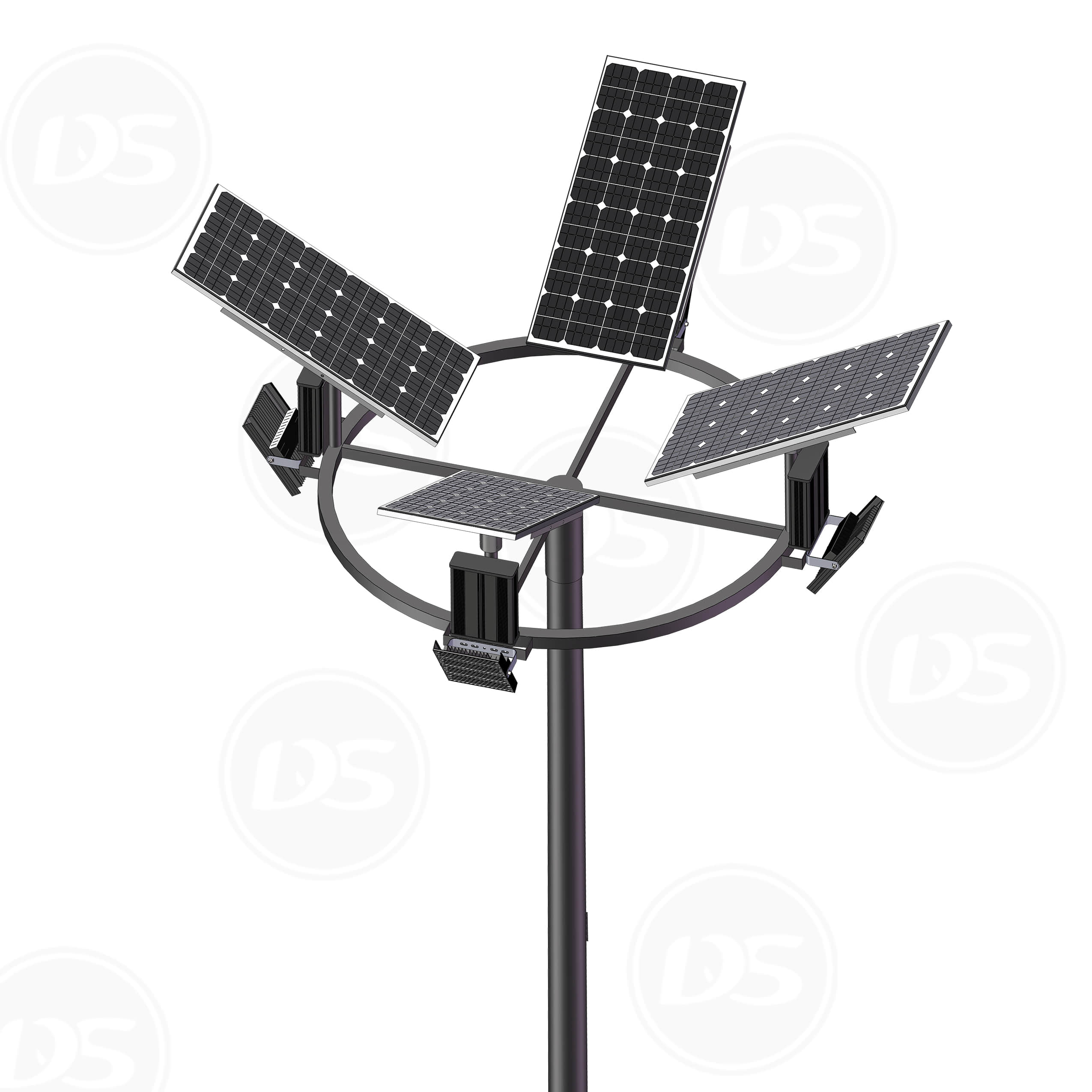
Split and semi-split solar street lights separate the solar panel from the LED fixture, while battery placement varies by design. Independent panel adjustment improves installation flexibility, and larger solar arrays or batteries can support higher lighting demands. These systems are suitable for highways, industrial areas, and locations with challenging sunlight conditions.
Feature | All-in-One Systems | Split / Semi-Split Systems |
|---|---|---|
Components | Integrated housing | Partially or fully separated |
Installation | Simpler and faster | Requires additional assembly |
Solar Panel Position | Limited adjustment | More flexible positioning |
Battery Capacity | Limited by housing | More flexible configurations |
Maintenance | Integrated component access | Components may be serviced separately |
Best Applications | Pathways, residential areas | Roads, industrial facilities |
Solar street light investment should consider equipment quality, installation costs, battery replacement, and ongoing maintenance. Evaluating total ownership costs helps buyers select reliable lighting systems while avoiding unnecessary long-term expenses.
Solar street light costs depend on component quality, battery capacity, and system design. Lower-priced fixtures may reduce initial spending but can increase replacement and maintenance expenses. Durable LED modules, suitable LiFePO4 batteries, and efficient solar panels can improve long-term value when properly sized and maintained.
Solar street light installation requires suitable mounting poles, foundations, and secure electrical connections. Pole height, structural strength, anchor bolts, and concrete foundations must match local wind conditions and engineering requirements. Proper site surveys and professional installation help improve safety and long-term reliability.
Solar street light maintenance in Nigeria should account for dust accumulation, high temperatures, and seasonal weather conditions. Regular solar panel cleaning, battery inspections, and connection checks help maintain charging efficiency and lighting performance. Maintenance frequency should reflect actual environmental conditions and manufacturer recommendations.
Anti-theft solar street lights can use tamper-resistant bolts, elevated mounting, reinforced battery enclosures, and secure access panels. These measures help protect valuable solar panels and batteries in public or remote locations. Integrated designs may also reduce exposed external components.
Purchasing solar street lights in Nigeria requires careful evaluation of technical specifications, supplier reliability, and after-sales support. Buyers should compare verified lighting performance, battery capacity, warranty terms, and component quality rather than relying solely on advertised wattage or low prices.
Solar street light wattage claims can be misleading when advertised power does not match actual system performance. Buyers should verify LED power consumption, luminous flux (lumens), solar panel wattage, and battery capacity in watt-hours (Wh). These specifications provide a more reliable basis for comparing lighting systems. Explore Dison's Solar Street Light range for different outdoor lighting applications.
Reliable solar street light suppliers should provide detailed technical specifications, clear warranty terms, replacement parts, and responsive technical support. Before placing bulk orders, buyers should confirm battery chemistry, solar panel specifications, IP ratings, and available certifications. Sample testing can also help verify performance and product quality.
Audit your site requirements to determine the exact lumen output needed for residential walkways versus high-traffic commercial zones.
Demand comprehensive technical data sheets from suppliers, focusing strictly on battery Amp-hours, panel wattage, and true Lumen output rather than printed model numbers.
Secure local fabrication estimates for 4mm thick galvanized poles and factor in the civil works required for deep concrete foundations.
Establish a strict bi-annual maintenance schedule to clean solar panels immediately after the heavy Harmattan dust season.
Specify proprietary anti-theft mounting hardware and enforce a minimum installation height of six meters to protect the physical assets from vandalism.
A: Battery lifespan depends entirely on the internal chemistry. Standard lithium-ion or lead-acid batteries typically fail within 6 to 12 months due to high ambient heat and deep discharging. Premium Lithium Iron Phosphate (LiFePO4) batteries are highly heat-resistant and can last between 3 to 5 years before requiring replacement.
A: You can mount lighter All-in-One fixtures on existing wooden poles using specialized bracket mounts. However, heavy-duty split systems require sturdy galvanized steel poles to support the weight of the large independent solar panels and resist high wind loads safely without snapping.
A: Premature shutoff usually indicates a depleted battery. This occurs if the solar panel is undersized, covered in heavy dust, or shaded by trees. It can also mean the internal battery has degraded and can no longer hold a full charge, requiring immediate replacement.
A: Heavy rain often washes away loose dirt naturally. However, you must schedule manual cleaning immediately after the Harmattan season. The fine dust that settles between December and February forms a thick layer that rain cannot easily remove, severely blocking sunlight absorption.
A: For standard estate roads and medium-traffic areas, a mounting height of 6 to 8 meters provides optimal light dispersion. This height also acts as a crucial security measure, keeping the valuable solar panels and batteries out of reach from casual vandals and thieves.
A: Utilize All-in-One systems where the battery is integrated into the high-mounted light fixture. If using split systems, house the external batteries in heavy-gauge steel enclosures welded directly to the pole. Always use specialized anti-theft shear bolts that require proprietary tools to remove.