Views: 0 Author: Site Editor Publish Time: 2026-10-14 Origin: Site
The transition to off-grid municipal, commercial, and industrial lighting is accelerating rapidly. Facility managers and urban planners want to eliminate trenching requirements and reduce grid dependency. However, the market remains highly fragmented. It is saturated with exaggerated performance claims and misleading specifications. Buyers face significant confusion over varying quality standards. This confusion often leads to the procurement of under-specced units. The result is premature battery failure and compromised site safety.
To prevent infrastructure failures, procurement teams must move beyond basic wattage metrics. You need a reliable method to verify component quality before installation. This guide provides an evidence-based framework. We will help you evaluate solar street light architectures and core component reliability. You will learn how to match technical specifications directly to your geographic realities and illumination requirements.
Architecture dictates application: All-in-one systems offer streamlined installation for standard projects, while split systems provide the necessary panel sizing and battery capacity for high-demand or low-sunlight regions.
Lumens over watts: Evaluate lighting efficacy based on total lumen output and optical distribution patterns, not just the wattage of the LED fixture.
Battery chemistry is the primary failure point: Prioritize LiFePO4 (Lithium Iron Phosphate) batteries paired with MPPT controllers to ensure 5-to-8-year maintenance-free lifespans.
Certifications mitigate risk: Demand verifiable IP65/IP66 ratings, IK08+ impact resistance, and standard electrical safety certifications (CE, RoHS, UL) before shortlisting vendors.
Table of Contents
You must differentiate between raw lumen output and effective ground illumination. Raw lumens measure the total light emitted by the LED source at the diode level. Effective ground illumination, measured in lux, defines the actual light reaching the pavement. A fixture producing 15,000 lumens is useless if poor optics scatter the light into the sky or create a blinding hotspot directly under the pole. You need secondary optical lenses designed to push light down and outward along the roadway.
Always request photometric plans from manufacturers. These are typically provided as IES files. Lighting engineers use IES files in simulation software like DIALux or AGi32. These simulations verify light distribution, calculate the uniformity ratio (the ratio of average lux to minimum lux), and highlight potential dark spots between poles. Without an IES file, you are guessing at the fixture's actual performance on your site. A uniformity ratio of 3:1 is standard for highways, while 5:1 is acceptable for general parking areas.
Match your pole height and spacing to the required lumen output. Different applications demand different configurations. Pedestrian pathways generally require 4-to-6-meter poles. They need lower lumen outputs to prevent glare for walkers. Multi-lane highways require 10-to-12-meter poles. These taller poles demand high-lumen fixtures with aggressive forward-throw optics to reach across multiple lanes without requiring poles on both sides of the street.
Application | Recommended Pole Height | Required Lumen Output | Optical Lens Type |
|---|---|---|---|
Pedestrian Pathways | 4 - 6 Meters | 2,000 - 4,000 Lumens | Type II / Symmetrical |
Residential Streets | 6 - 8 Meters | 5,000 - 8,000 Lumens | Type II / Type III |
Commercial Parking Lots | 8 - 10 Meters | 9,000 - 12,000 Lumens | Type III / Type IV |
Multi-Lane Highways | 10 - 12+ Meters | 12,000 - 18,000+ Lumens | Type III (Long Throw) |
Local Peak Sun Hours (PSH) dictate your entire system design. PSH is not the same as daylight hours. It measures the equivalent hours of sunlight at an intensity of 1,000 watts per square meter. A location might have 12 hours of visible daylight in winter but only 2.5 PSH. You must calculate the required solar panel wattage and battery capacity based strictly on your worst-case winter PSH averages. Using summer PSH data will guarantee system failure in December.
Factor in autonomy days when sizing the battery bank. Autonomy refers to the system's ability to operate during consecutive cloudy or rainy days without receiving a full charge. Standard commercial projects require three to five days of autonomy. Sizing the system for high autonomy ensures operational reliability during extended bad weather. It prevents the battery from draining completely, which protects its long-term health and prevents the low-voltage disconnect from shutting down the lights.
Evaluate temperature extremes at your installation site. High heat degrades battery life rapidly. Sustained temperatures above 45°C (113°F) accelerate chemical breakdown inside the cells. Conversely, sub-zero temperatures severely impact charge acceptance. Lithium batteries cannot accept a fast charge when frozen. You must select battery chemistries and enclosures designed to handle your specific local climate. In extreme cold, you may need insulated battery boxes buried below the frost line.
All-in-One solar street lights integrate the solar panel, LED fixture, battery, and controller into a compact housing. This design reduces external wiring, simplifies installation, and lowers maintenance complexity. They are suitable for parks, residential roads, and commercial parking lots. However, limited panel adjustment and battery space may affect performance in low-sunlight regions.
Explore Dison's All-in-One Solar Street Lights for different outdoor lighting applications.
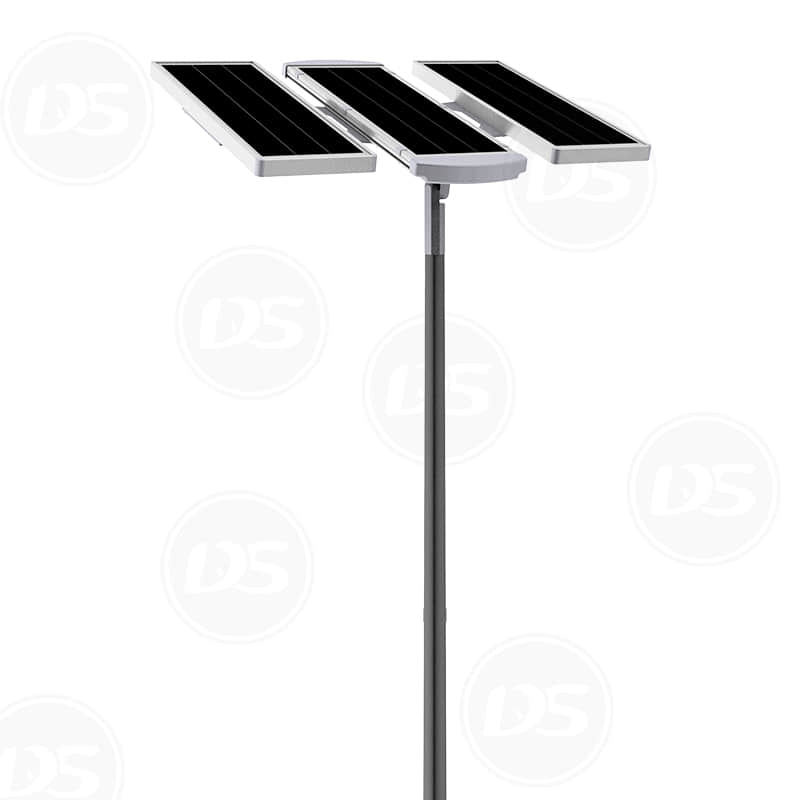
Split and semi-split solar street lights separate the solar panel from the LED fixture, while battery placement varies by configuration. Independent panel positioning allows better sunlight collection, and flexible battery sizing supports higher power demands and longer backup periods. These systems are suitable for highways, industrial facilities, and regions with limited winter sunlight, although installation requires additional wiring and mounting components.
Solar street light panels convert sunlight into electricity, with monocrystalline panels widely preferred for their high conversion efficiency and compact design. Proper panel sizing should consider daily power consumption, peak sun hours, seasonal weather, and charging losses. Quality encapsulation and durable glass also help maintain long-term performance.
LiFePO4 solar street light batteries offer long cycle life, good thermal stability, and higher usable capacity than traditional lead-acid batteries. A reliable Battery Management System (BMS) provides essential protection against overcharging, deep discharge, short circuits, and extreme temperatures. Proper battery sizing and thermal management help ensure consistent nighttime operation.
Battery Type | Main Advantages | Key Limitations |
|---|---|---|
Lead-Acid | Lower initial cost | Heavy, lower usable capacity |
Lithium-ion | High energy density | Performance depends on chemistry and thermal protection |
LiFePO4 | Long cycle life, thermal stability | Higher initial investment |
High-efficiency solar LED street lights use suitable LED chips, effective heat dissipation, and precision optical lenses to deliver consistent illumination. Buyers should evaluate luminous efficacy, lumen maintenance, beam distribution, and color temperature. Appropriate Type II or Type III optics can improve roadway coverage, while warmer color temperatures may help reduce light pollution.
Explore Dison's Solar Street Light range for different roadway and outdoor lighting applications.
Solar street light charge controllers regulate battery charging and manage energy distribution. MPPT controllers can improve solar energy harvesting compared with PWM systems, particularly when panel and battery voltages differ. Smart controllers may also support programmable dimming, motion sensors, and remote monitoring to optimize battery usage.
Explore Dison's Solar Street Lights with IoT Systems for intelligent lighting management.
Solar street light certifications help buyers evaluate product safety, environmental protection, and manufacturing quality. Requirements vary by country and project, so procurement teams should verify applicable standards, test reports, and supplier documentation before purchasing.
IP and IK ratings indicate a solar street light's resistance to environmental exposure and physical impact. IP65-rated fixtures provide dust-tight protection against water jets, while higher protection levels may suit demanding installations. IK ratings help assess resistance to mechanical impacts, particularly in public and industrial environments.
Solar street light suppliers should provide relevant compliance documentation, such as CE conformity records, RoHS compliance information, and applicable EMC test reports. ISO 9001 certification can also indicate an established quality management system. Buyers should verify certificate validity, product coverage, and independent testing where required.
Selecting reliable off-grid lighting requires balancing your geographic realities with component quality. There is no universal solution. Your chosen architecture must follow your specific application. Prioritize high-efficiency components and robust environmental protections to ensure long-term stability.
Apply strict shortlisting logic to your vendor evaluation. Immediately disqualify vendors offering lead-acid batteries. Reject PWM controllers for high-wattage systems. Eliminate any manufacturer that cannot provide verifiable photometric data and IES files for their fixtures.
Take the following actionable steps to finalize your project:
Audit your specific site's winter peak sun hours (PSH) using local meteorological data.
Define your exact lumen output requirements and mandate a minimum of three autonomy days.
Request physical sample units from your shortlisted manufacturers to verify build quality.
Demand comprehensive warranty documentation covering the battery, controller, and LED degradation before committing to a bulk order.
A: Lumen requirements depend heavily on the specific application and pole spacing. Pedestrian pathways typically need 2,000 to 4,000 lumens to ensure safety without causing glare. Residential streets require 5,000 to 8,000 lumens. Multi-lane highways and large commercial parking lots demand 10,000 to 15,000+ lumens. Always use photometric simulation software like DIALux to match the lumen output with your specific pole height, spacing, and required ground lux levels.
A: Integrated all-in-one lights house the solar panel, battery, and LED inside a single chassis for rapid installation. Split lights separate these components. Split systems allow for much larger battery banks, higher wattage solar panels, and fully adjustable panel tilt angles. This makes split systems mandatory for heavy-duty lighting needs or geographic areas with low winter sunlight.
A: Battery lifespan depends entirely on the specific chemistry and thermal management. Modern LiFePO4 (Lithium Iron Phosphate) batteries are the industry standard. They typically last 5 to 8 years in outdoor environments. They offer over 2,000 charge cycles before their capacity drops below 80%, far outperforming outdated lead-acid technology.
A: MPPT (Maximum Power Point Tracking) controllers actively adjust the voltage and current to extract maximum power from the solar panel. They are up to 30% more efficient than standard PWM controllers. This extra efficiency is mandatory for charging batteries fully during cloudy days, overcast weather, or short winter afternoons.
A: Yes, if the system is sized correctly. Reliable operation relies on calculating the system's autonomy days. By oversizing the battery capacity and solar panel during the engineering phase, the system stores enough reserve power to keep the lights running for 3 to 5 consecutive cloudy or rainy days without receiving a full charge.
A: Monocrystalline solar panels are the best choice for all commercial applications. They offer the highest efficiency rates, typically between 20% and 22%. They generate more power in a smaller physical footprint and perform significantly better in low-light conditions. Ensure the panels feature tempered glass and robust encapsulation to withstand extreme environmental stress.