
Views: 0 Author: Site Editor Publish Time: 2026-01-09 Origin: Site
Spec sheets can look clear. Yet they often hide key risks.
In this article, we break down solar led street light tech specs. You will learn watts, lumens, optics, battery, and panel basics. We also show how to match them to real road needs.
Wattage on a brochure can mean different things. Some suppliers list “equivalent wattage” to compare old HPS lamps, not real energy use. You should ask for real input power at full brightness, measured in watts. It tells you the true load your battery must support every night.
Also ask if it uses constant power or adaptive power. Adaptive power reduces output after peak hours, then saves battery energy. It can improve runtime during cloudy weeks and winter seasons. If you compare products, compare them at the same brightness profile and the same test method.
Note: If a quote only says “100W,” ask for “measured input watts at full output.”
Lumens tell total light output, but roads need usable light on the ground. A higher lumen number does not always mean better visibility. Optics can waste light in the sky or create glare near the pole. You should request a lighting simulation based on your pole height and spacing.
Ask for photometric data such as an IES file or a lux map. It helps you check average lux and uniformity before you buy. It also reduces rework after installation, which protects project timelines. When you compare quotes, keep the same road width, same pole height, and same spacing.
Efficacy means lumens per watt for the full system, not only the LED chip. Many sheets show “chip efficacy,” which looks higher than real output. System efficacy includes driver losses and optical losses. It is a better signal for battery sizing and nightly runtime.
Heat also changes efficacy during real operation. A lamp may run hot in summer and drop output over time. Ask for system efficacy at operating temperature, not only lab values. Higher system efficacy usually means you can use a smaller battery, or gain longer autonomy.
Optics decide where your lumens actually land. A wide road needs forward throw to reach the far lane. A walkway needs controlled distribution to avoid glare and light spill. Beam angles help, but distribution type matters more than a single angle number.
Ask if the lens supports common road patterns like Type II or Type III. Also check lens material and aging resistance. Cheap lenses can yellow or crack after long UV exposure. Good optics improve uniformity, reduce complaints, and raise perceived quality.
Battery quality controls runtime, replacement cost, and site visits. You should check battery voltage, Ah, and total energy in Wh. Wh is the clearest unit for runtime planning, since it links directly to watts and hours. Also ask for usable energy based on the allowed discharge limit.
Ask for cycle life at a stated depth of discharge and temperature. A battery can look strong on day one, yet fade fast under deep cycling. Cold climates reduce capacity, while hot climates accelerate aging. Your spec should match your site climate and your service plan.
Solar panel wattage must match your daily load and local sun conditions. A higher night load demands more panel Wp, especially in winter. Ask for Vmp and Imp, not only Wp, because the controller needs a correct voltage range. If the panel voltage does not match the controller, charging will suffer.
Also check panel placement risk, such as shade from trees or poles. Even small shading can reduce charging sharply. Ask about glass thickness, frame strength, and surface coating. Durable panels protect long-term charging performance and reduce failures.
Table 1 — Quick spec checklist for buyers
Spec item | What it means | What to request | Why it matters |
Input watts | Real power draw | Test data at full output | Sets battery and panel size |
Lumens and lux | Output and ground light | IES file or lux map | Avoids dark spots and glare |
System efficacy | lm/W for the whole lamp | System value, not chip-only | Predicts real efficiency |
Optics | Distribution quality | Beam type and lens material | Improves uniformity and safety |
Battery energy | Storage in Wh | V, Ah, Wh, DoD, cycle life | Predicts runtime and life cost |
Panel output | Charging capability | Wp, Vmp, Imp | Ensures recharge in local sun |
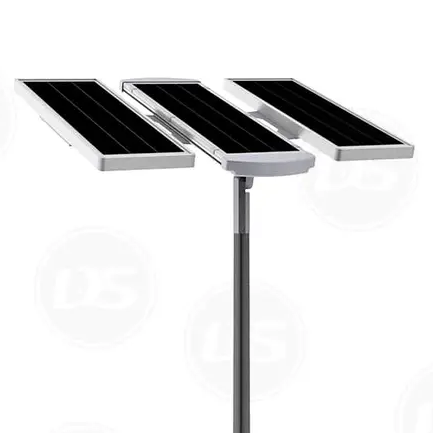
Pole height changes both brightness and uniformity. Higher poles need more lumens to reach the same ground lux. They also need better optics to control glare near the pole. If you raise height without changing optics, you may get uneven lighting.
Spacing should come from a lighting plan, not guesswork. Wider spacing saves poles but can create dark gaps. Tighter spacing raises CAPEX and can waste energy. You should size the system as one set, including pole, arm length, and tilt angle.
Road width sets how far the beam must throw. A narrow lane can use a tighter distribution. A wide road needs forward throw and good cutoff control. The best approach is to define target lux and uniformity for your road class.
Ask suppliers to simulate your exact layout, then review the lux results. It is easier than fixing lighting after installation. It also helps you avoid overspec designs that waste budget. If you have multiple road types, create multiple spec profiles.
Runtime means hours of lighting each night. Autonomy means how many low-sun days the system can survive. Many suppliers mix these terms, so buyers get confused. You should ask for both values, tied to a clear dimming schedule.
Ask how they define “rainy day,” and what brightness they used. Some claims assume very low output most of the night. For real roads, you may need a higher baseline level. A good spec includes a realistic schedule and a realistic climate assumption.
Dimming can save battery energy without hurting safety, if used correctly. For residential streets, it often works well after midnight. For parks or low-traffic roads, motion sensing can boost light only when needed. The key is sensor quality and correct tuning.
Ask what sensor type they use and how far it detects. Microwave sensors can cover larger areas than PIR in some cases. Also ask if profiles can be adjusted after installation. Field tuning helps you balance safety, energy, and autonomy.
Tip: Ask for a “system balance” summary: nightly Wh load, panel Wp, and expected autonomy under your local sun.
Table 2 — Simple matching guide for common projects
Project type | Typical pole height | Common spacing approach | Useful lighting mode |
Pathway or park | 3–6 m | Moderate spacing, controlled beam | Motion boost plus baseline dim |
Residential street | 6–8 m | Balanced spacing, Type II/III optics | Scheduled dim after midnight |
Arterial road | 8–10 m | Simulation-led spacing and throw | Constant output or mild dim |
Rural off-grid road | 6–9 m | Wider spacing, higher autonomy | Strong autonomy, stable output |
Lithium batteries usually deliver higher usable energy in a smaller size. They also handle deeper discharge better across many cycles. That often means longer service life and fewer replacements. For remote roads, fewer site visits can justify the higher upfront cost.
Lead acid batteries can still fit some projects with tight budgets. Yet they dislike deep discharge and high heat exposure. They can lose capacity faster, then reduce autonomy over time. When you compare options, compare total lifecycle cost, not only purchase price.
Depth of discharge controls how much battery energy you use each night. Higher discharge can extend runtime today, but it can shorten life over years. Cycle life must be stated at a specific discharge level and a specific temperature. Without those details, the claim is weak.
Ask for usable capacity rules built into the controller. Good controllers protect the battery by limiting deep discharge. That can increase lifetime and reduce warranty claims. It also keeps light stable across seasons, which improves public trust.
Note: If cycle life lacks DoD and temperature, treat it as marketing, not engineering data.
Charging depends on panel size and the local solar window. Winter sun hours can be much lower than summer sun hours. If you size only for summer, the system may dim too early in winter. You should estimate local sun hours and match panel Wp to daily Wh demand.
Controller type also impacts harvest efficiency in variable sunlight. MPPT can harvest more energy during cloudy weather and partial shading. PWM can work well in stable, bright conditions when voltage matches. Choose based on climate, site shading risk, and system power level.
Temperature impacts both LEDs and batteries every night. High heat reduces LED output and speeds driver aging. It also increases battery stress during charging. Cold reduces battery capacity and can limit discharge current. Both effects change real runtime at the site.
Ask for operating temperature ranges and thermal design details. Good heat sinks help the LED run cooler and maintain lumen output longer. For cold sites, ask about low-temperature battery options or cold charging protection. These details reduce winter failures and service calls.
The controller manages charging, discharging, and lighting logic. PWM controllers are simpler and cheaper, and they can perform well in stable conditions. They often require closer matching between panel voltage and battery voltage. MPPT controllers track the best power point of the panel, then improve harvest under changing sun.
MPPT also supports wider panel voltage ranges, which helps in higher power systems. It can raise charging efficiency in cloudy climates and shoulder seasons. For many municipal projects, the extra harvest can protect autonomy targets. Still, you should confirm the MPPT rating, range, and protection features.
Most systems switch on at dusk and off at dawn using light sensing. It can be an LDR sensor or a voltage-based logic design. You should ask how it avoids false triggers during storms and headlights. A stable switch prevents flicker and protects battery energy.
Also ask for delay settings and brightness ramp behavior. Smooth ramping improves user comfort and reduces sudden glare. Good control logic helps keep lighting predictable, which supports public safety goals. It also reduces complaints that create extra work for project teams.
Protection functions prevent common field failures. You should check overcharge, overdischarge, and overcurrent protection. Reverse polarity protection helps during maintenance and wiring mistakes. Short circuit protection reduces fire risk and limits damage after accidents.
Surge and lightning protection also matter for exposed poles. Ask for surge ratings and grounding guidance. Many failures come from poor grounding, not from weak products. A clear wiring diagram and grounding plan can reduce early breakdowns.
Remote monitoring supports city-scale deployments and EPC teams. It helps you see battery status, charging behavior, and fault codes from one dashboard. It also helps you locate failures faster, which reduces night inspections. For remote roads, it can reduce travel and labor costs.
Ask what network they use and what the data costs are. Some use LoRa, some use cellular, and some use mesh networks. Also ask how firmware updates work and who owns the data. Clear answers help you avoid hidden costs after installation.
Tip: For large tenders, remote monitoring can reduce OPEX and shorten repair response time.
Table 3 — Controller comparison for procurement
Item | PWM controller | MPPT controller |
Cost | Lower | Higher |
Harvest efficiency | Good in stable sun | Better in variable sun |
Panel voltage flexibility | Limited | Wider range |
Best fit | Small systems, stable climates | Larger systems, mixed climates |
Buyer question | “What is panel Vmp?” | “What is MPPT range and rating?” |
Outdoor lights face rain, dust, insects, and pollution. IP65 or IP66 is common for street fixtures. Yet IP rating does not cover corrosion risk in coastal zones. You should ask about coating quality and corrosion testing for metal parts.
Ask about salt spray results if the site is near the sea. Also check fasteners, cable glands, and sealing design. Weak sealing often causes early driver failures. A robust enclosure reduces water entry and protects electronics for years.
Panels increase wind load, especially on tall poles. Ask for wind rating or structural design guidance. Brackets, arms, and bolts must handle peak wind conditions. If the mount fails, it becomes a safety risk and a project liability.
Also consider theft and vandalism risks. Battery placement affects theft exposure and service access. Some designs place batteries high for security, while others use tamper-resistant boxes. Good mounting design improves safety and reduces unexpected replacements.
Street poles sit in open areas, so surges can be frequent. Lightning does not need a direct hit to cause damage. Induced surges can destroy controllers and drivers quickly. You should ask about surge protection integration and the recommended grounding method.
Ask for clear grounding requirements and target earth resistance values. Poor grounding can void warranties and raise failure rates. A good installation standard can prevent most surge-related issues. It is often cheaper than repeated component replacement.
Warranty terms reflect supplier confidence and product quality. Ask what parts are covered and what exclusions apply. Batteries often have separate warranty rules. You should confirm battery warranty duration and replacement terms clearly.
Also ask about spare parts availability and lead times. For remote projects, long lead times can leave sites dark. A supplier should provide troubleshooting steps and support channels. Good service terms reduce downtime and protect your project reputation.
Note: A long warranty matters less if spare parts and support are weak.
In conclusion, understanding the solar LED street light tech specs is essential for selecting the right lighting system. Key factors like wattage, lumens, optics, and battery capacity must be carefully matched to your specific lighting needs. By considering these factors, you can ensure reliable, efficient, and long-lasting street lighting solutions.
For high-performance solar LED street lights, Dison Group offers reliable products designed to meet the diverse needs of municipalities and businesses. Their lights are engineered for durability, energy efficiency, and sustainability, making them an excellent investment for future-proof urban infrastructure.
A: Solar LED street lights are outdoor lighting systems powered by solar energy. They use solar panels to charge batteries during the day, which then power energy-efficient LED lights at night, providing eco-friendly and cost-effective illumination.
A: Solar LED street lights work by converting sunlight into electricity using solar panels. The generated energy is stored in batteries, which power the LED lights during the night, ensuring continuous illumination without relying on grid electricity.
A: Solar LED street lights reduce electricity costs by using solar energy, eliminating the need for power from the grid. Additionally, they require minimal maintenance due to their long lifespan, making them a cost-effective solution for street lighting.
A: When selecting solar LED street lights, key factors to consider include wattage, battery capacity, solar panel efficiency, light distribution, and the installation environment (such as pole height, spacing, and weather conditions).
A: Solar LED street lights typically last between 10 to 20 years, depending on the quality of components like the LED lamps, solar panels, and batteries. Proper maintenance and optimal environmental conditions can extend their lifespan.


