
Views: 0 Author: Site Editor Publish Time: 2026-01-09 Origin: Site
Are you ready to revolutionize outdoor lighting with solar powered street lights?
In this article, we’ll explain how solar powered street lights with IoT systems work and why they are a game-changer for modern urban infrastructure. You’ll learn about the components that make these systems energy-efficient, cost-effective, and reliable. By the end, you’ll understand how integrating IoT can optimize lighting performance and improve maintenance.
The heart of solar powered street lights is the solar panel, which collects energy from the sun during daylight hours and converts it into electricity. This energy is stored in batteries, which power the lights at night. The efficiency of the solar panel directly impacts how much energy is collected and how well the system will function in less sunny regions.
● Monocrystalline vs. Polycrystalline Panels: Monocrystalline panels, known for their high efficiency, are often the top choice for solar street lights. However, polycrystalline panels are more cost-effective and can still perform well, particularly for less demanding applications.
● Panel Placement and Orientation: The solar panels must be placed in positions where they receive maximum sunlight throughout the day, ensuring that the batteries are fully charged. Tilted and optimal positioning of the panels enhances the system's energy collection, especially in regions with limited sunlight.
This system, once installed, operates autonomously and is designed to require minimal maintenance, making it ideal for cities looking to cut down on both energy and labor costs.
Batteries are another crucial component of solar powered street lights. They store the energy captured by the solar panels during the day and provide power to the lights when the sun sets. The type of battery used, along with its capacity, directly influences how long the lights can operate throughout the night and in inclement weather conditions.
● Lithium-ion vs. Lead-acid Batteries: Lithium-ion batteries are preferred for modern solar powered street lights due to their longer lifespan, higher efficiency, and better performance in a range of temperatures. They also charge faster and have a higher depth of discharge compared to lead-acid batteries. However, they come at a higher initial cost.
● Battery Capacity: The battery capacity (measured in watt-hours or amp-hours) should be large enough to power the lights during the night, considering the energy consumption and regional weather conditions. This ensures that the lights will still function effectively even during extended cloudy days.
The right battery size is key for ensuring the lights have adequate autonomy to last throughout the night and beyond. Higher-quality batteries can also ensure better performance and longevity, which reduces the need for frequent replacements.
A smart controller is an integral part of solar powered street lights with IoT systems. It manages the energy flow between the solar panel, battery, and light. The controller ensures that the battery is charged appropriately during the day and prevents overcharging, which could damage the battery.
● Dusk to Dawn Control: The controller uses a light sensor to automatically detect when to turn the lights on at dusk and off at dawn. This is a basic yet essential feature for ensuring the light functions only when necessary, conserving energy during daylight hours.
● Time-Based Dimming: Many advanced systems also offer time-based dimming. The controller dims the light to a lower level at certain times of the night when less brightness is needed, further saving energy. This feature is particularly useful in areas with lower traffic or during late-night hours when full brightness is not required.
Incorporating smart controls means that solar street lights can operate more efficiently, adjusting to environmental conditions in real-time without requiring manual intervention. Additionally, the controller can also be integrated with IoT systems for enhanced monitoring and management.
One of the standout features of solar powered street lights with IoT systems is the ability to remotely control and monitor the lighting network. Through IoT integration, these systems connect to a cloud platform, enabling cities and operators to access real-time data such as battery status, solar input, and operational efficiency.
● IoT Communication Technologies: These lights communicate using wireless technologies like LoRa, Zigbee, or 4G LTE to send data to the cloud. These technologies ensure a reliable connection even in remote or expansive areas.
● Remote Monitoring and Management: IoT integration allows operators to monitor the lighting status, detect faults, and adjust brightness or schedules remotely. If a light fails or requires maintenance, the system sends an alert, enabling swift action.
This system greatly reduces the need for manual inspection and maintenance, improving operational efficiency and minimizing downtime. Additionally, the real-time feedback helps cities optimize energy use, making it easier to identify and rectify issues promptly.
Motion sensors are a key feature in solar powered street lights with IoT systems. These sensors detect movement and adjust the light’s brightness accordingly. When no movement is detected, the light dims, conserving energy.
● PIR Sensors: Passive Infrared (PIR) sensors detect heat from people or vehicles and increase the light’s brightness when movement is detected. When there’s no motion, the system dims to save energy.
● Microwave Sensors: These sensors work by emitting microwave signals and detecting any reflection, which makes them more sensitive and capable of detecting motion from greater distances.
The integration of motion sensors with IoT-enabled solar street lights optimizes energy use while ensuring that areas are always properly lit when needed.
Tip: Motion sensors not only save energy but also provide increased safety by ensuring that bright light is available whenever someone is nearby, especially in poorly lit areas.
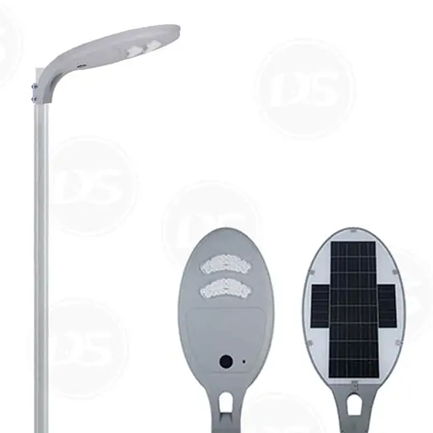
By combining solar power with IoT technology, these street lights operate independently of the grid and use renewable energy. The integration of motion sensors ensures that the light dims when no one is nearby, leading to substantial energy savings.
● Smart Dimming: The ability to adjust the brightness in real-time based on motion saves up to 50% more energy compared to traditional street lights.
Since solar powered street lights with IoT integration do not rely on the electrical grid, they eliminate monthly electricity bills and reduce the costs associated with grid-based lighting systems. Additionally, these systems require less frequent maintenance due to their durable construction and smart monitoring capabilities.
● Lower Maintenance Costs: IoT allows for predictive maintenance, identifying potential issues before they become major problems and reducing the need for frequent repairs.
The integration of motion sensors and IoT technology enhances both safety and security. These lights automatically adjust brightness based on movement, ensuring that public spaces are well-lit at all times, enhancing visibility and deterring crime.
● Real-Time Monitoring: IoT-enabled systems allow for real-time monitoring, meaning that any failure or malfunction is detected immediately, ensuring the lights are always functioning properly.
Table 1 — Advantages of Solar Powered Street Lights with IoT
Benefit | Description |
Energy Efficiency | Solar power and motion sensors reduce energy consumption. |
Cost Savings | Eliminates grid electricity costs and reduces maintenance. |
Remote Monitoring | IoT enables remote management and real-time data analysis. |
Security Enhancement | Motion sensors increase brightness when needed, enhancing safety. |
Predictive Maintenance | IoT detects faults early, reducing downtime and repair costs. |
In conclusion, solar powered street lights with IoT integration offer sustainable, energy-efficient, and cost-effective solutions for modern urban infrastructure. These lights not only reduce dependency on the grid but also provide enhanced safety through smart sensors and remote monitoring. By incorporating IoT technology, cities can better manage their lighting systems and ensure optimal performance while saving energy.
For reliable and high-performance solar powered street lights, Dison Group offers innovative solutions that integrate the latest IoT technology. Their products are designed to deliver long-lasting, eco-friendly illumination that meets the needs of today’s smart cities, ensuring both sustainability and safety.
A: Solar powered street lights are outdoor lighting systems that use solar energy to power the lights. These lights have solar panels that collect sunlight during the day, which is stored in batteries and used to power the lights at night.
A: Solar powered street lights with IoT systems use solar panels to generate energy and store it in batteries. IoT integration allows for real-time monitoring, remote control, and energy optimization through smart sensors and controllers.
A: Solar powered street lights reduce reliance on grid electricity, lower energy costs, and minimize carbon footprints. They offer a sustainable, reliable, and cost-effective lighting solution for both urban and rural areas.
A: IoT integration allows for remote monitoring, real-time data analysis, and automatic adjustments based on environmental conditions, making solar powered street lights more efficient and easier to manage.
A: Yes, solar powered street lights are designed to withstand various weather conditions. With waterproof features and durable materials, they can function effectively in rain, snow, and extreme temperatures.


