
Views: 0 Author: Site Editor Publish Time: 2026-05-09 Origin: Site


Have you ever wondered how airports and stadiums stay brightly lit at night? The answer often lies in a high mast light pole. These towering poles provide wide-area illumination, enhanced safety, and easy maintenance for large spaces. In this article, you will learn what a high mast light pole is, how it works, and why it’s a crucial solution for industrial, commercial, and recreational areas.
A high mast light pole is a tall outdoor lighting structure designed for illuminating large areas efficiently. Unlike standard street poles, they are much taller, often ranging between 15 and 50 meters, and carry multiple high-power fixtures. They are ideal for locations where a single pole must cover a wide area, reducing the need for multiple smaller lights. They are commonly installed in stadiums, airports, ports, highways, and large parking lots.
Key Differences Between High Mast Poles and Standard Street Poles:
Feature |
High Mast Pole |
Standard Street Pole |
|---|---|---|
Height |
15–50 meters |
6–12 meters |
Number of Fixtures |
4–12 or more |
1–2 |
Coverage Area |
Wide, up to several hectares |
Limited, mostly local streets |
Maintenance |
Often uses lifting system |
Manual climb or cherry picker |
Application |
Airports, stadiums, highways |
Streets, sidewalks, small parking lots |
High mast poles support not just multiple lights but also electrical and control systems, sometimes including remote controls or automated timers. Their design ensures both stability and visibility in areas exposed to wind or other environmental challenges. Dison’s solutions, for instance, often feature hot-dip galvanized steel to resist corrosion, ensuring long-term durability.
To understand how these towers illuminate huge areas, imagine lights positioned high above the ground, casting beams across every corner. The principle is simple: raise the fixtures, spread the light, maintain easily. Yet, each element is engineered for maximum efficiency.
For instance, consider these operational highlights:
Lighting Distribution: The lights are arranged strategically, often in a circle around the pole. This configuration helps avoid harsh shadows, creating smooth, consistent illumination.
Height Advantage: Taller poles cover broader spaces, meaning fewer poles achieve the same or better lighting compared to multiple shorter poles. It’s a simple way to reduce clutter while increasing visibility.
Maintenance Systems: Many poles feature winches or automated lowering mechanisms. This allows the luminaire ring to descend safely, so technicians can inspect, clean, or replace fixtures without climbing, reducing risk and downtime.
An example setup could be illustrated in a practical table:
Pole Height |
Number of Fixtures |
Typical Application |
|---|---|---|
15–20 m |
4–6 |
Small parking lots, industrial yards |
25–30 m |
6–8 |
Medium stadiums, airports, ports |
35–40 m |
8–12 |
Large stadiums, highway interchanges |
45–50 m |
12+ |
Major ports, logistics hubs, large open areas |
Dison incorporates these design principles into their high mast poles, often pairing corrosion-resistant steel with optional solar-powered LED fixtures, which adds versatility for off-grid or remote projects. The combination of height, lighting design, and maintenance innovation makes them not just poles, but reliable lighting solutions for complex environments.
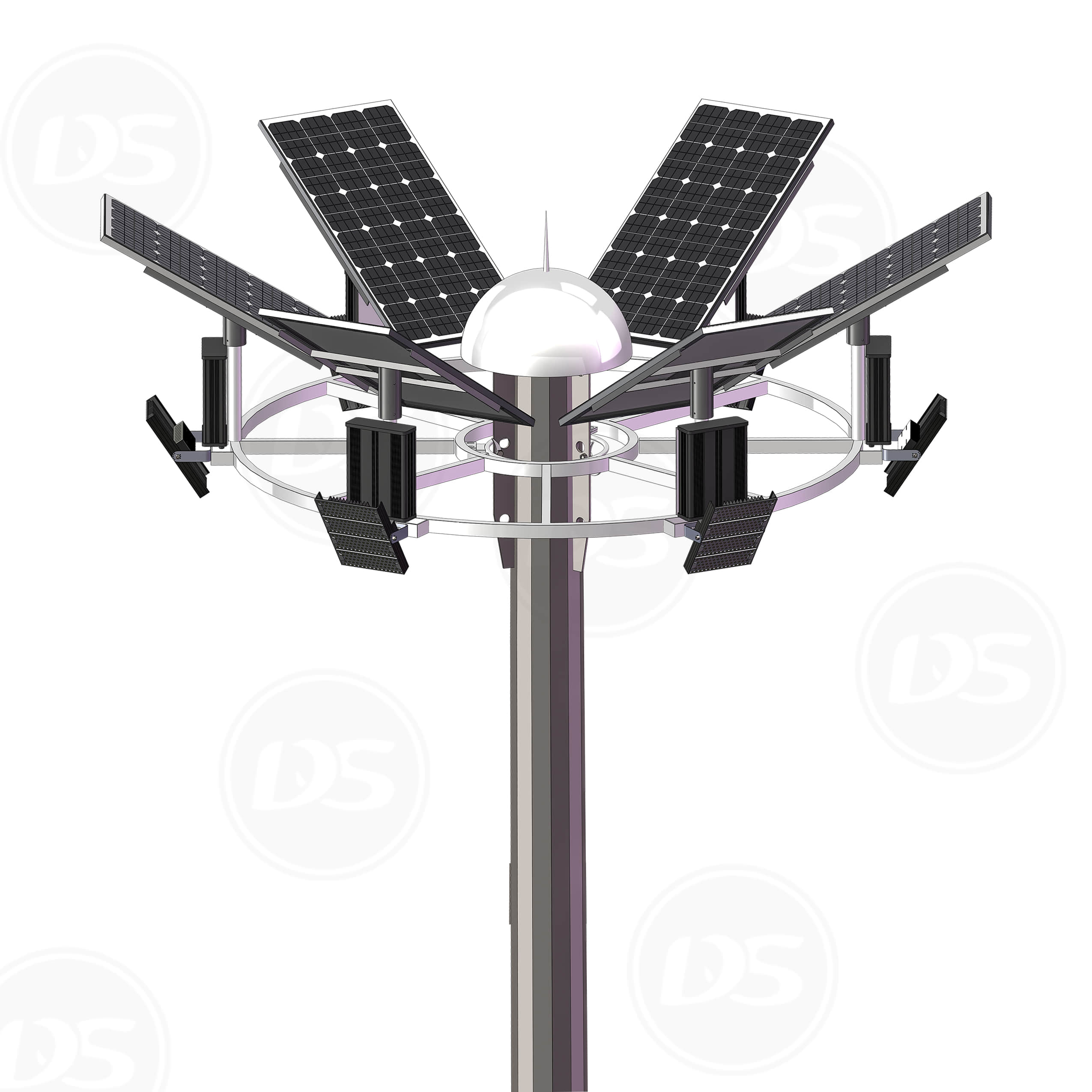
When it comes to ensuring a high mast light pole withstands years outdoors, the materials set the foundation for everything else. They determine not just strength but longevity and reliability in challenging conditions.
Before looking at the structure, consider these material advantages:
Steel Selection: High mast poles typically use Q235 steel, providing excellent tensile strength and flexibility. This choice allows the pole to support multiple heavy fixtures and endure strong winds without bending or compromising stability.
Corrosion Protection: To survive rain, snow, and pollution, most poles undergo hot-dip galvanization, creating a durable zinc coating that prevents rust and prolongs service life, keeping the pole looking and performing like new for decades.
Marine-Grade Coating Option: In coastal or highly humid environments, optional marine-grade coatings provide extra defense against salt spray and moisture, reducing maintenance and enhancing both safety and appearance over time.
These careful material choices form the backbone of a high mast lighting system, ensuring it remains safe, durable, and functional under heavy daily use.
Once materials are chosen, the way the pole is built defines its real-world performance. Every detail matters, from diameter to tapering, because high mast poles must withstand both environmental pressures and operational stress.
Think about these design elements:
Wind Resistance: High mast poles are engineered to resist wind speeds over 30 m/s, and some designs tolerate gusts up to 60 m/s, maintaining stability in extreme weather without swaying or tipping.
Pole Dimensions: Designers carefully calculate diameter, wall thickness, and tapering, balancing structural integrity with material efficiency. This ensures the pole can carry multiple fixtures while remaining lightweight enough for safe installation.
Safety Features: Technicians often need access for maintenance, so many poles include cages, ladders, and platforms, letting crews perform inspections or repairs safely without scaffolding or lifts.
By focusing on design details, high mast poles combine robustness with practical usability for long-term reliability.
Finally, the lighting system itself defines how effectively the high mast pole illuminates large areas. It’s not just about height—how light is distributed matters as much as the steel that supports it.
Consider the technology advantages in this context:
LED Efficiency: Modern high mast poles often mount LED fixtures, which consume less energy, last longer, and offer brighter, more uniform illumination than traditional lamps. This improves visibility and reduces operational costs.
Maintenance Convenience: Paired with raising and lowering systems, LEDs allow ground-level maintenance, letting technicians inspect, replace, or clean fixtures without climbing, enhancing both safety and workflow efficiency.
Optimal Light Distribution: Fixtures are designed to deliver even, glare-free lighting, covering stadiums, highways, ports, or industrial yards without shadows, making the space safer and more functional for people and vehicles alike.
By combining strong materials, smart structural design, and advanced LED technology, high mast light poles create reliable, energy-efficient, and long-lasting lighting solutions. Dison integrates all these elements, producing poles that perform consistently while simplifying maintenance and maximizing safety.
When planning lighting for large industrial or commercial areas, a simple streetlight often falls short, leaving dark spots and safety hazards. High mast light poles solve these issues by elevating multiple powerful fixtures above the ground, spreading light evenly across wide spaces. Airports, ports, highways, and intersections benefit from this design because visibility directly impacts safety and efficiency. Factories, logistics hubs, and parking lots also rely on them to maintain secure and productive environments day and night.
To illustrate how they make a difference:
Air Traffic Safety: High mast poles illuminate runways and aprons effectively, reducing shadowed areas and helping ground staff navigate safely at night.
Cargo Operations: Ports gain consistent lighting across docks and storage areas, enabling safer and faster loading, unloading, and transport.
Traffic Flow Improvement: On highways and intersections, tall poles enhance driver visibility over long distances, helping prevent accidents in busy or poorly lit areas.
Industrial Productivity: Factories and logistics yards benefit from fewer poles covering large areas, which minimizes installation costs while maintaining security and visibility.
A quick reference to industrial applications:
Area |
Lighting Advantage |
|---|---|
Airports |
Uniform runway illumination, improved night operations |
Ports |
Enhanced cargo handling visibility, reduced accidents |
Highways & Intersections |
Safer navigation, reduced dark zones |
Industrial Yards & Parking |
Efficient coverage, improved security |
Sports venues and outdoor arenas require bright, uniform lighting for both performance and spectator experience. High mast light poles help facilities meet these needs efficiently, ensuring athletes and fans can see clearly during nighttime events.
Field Coverage: High mast poles raise lighting above courts or fields, delivering even brightness and minimizing shadows that could interfere with play or visibility.
Audience Safety: Well-illuminated seating and concourse areas reduce the risk of trips and accidents during events, creating a safer environment for everyone.
Broadcast Quality: Elevated lighting helps cameras capture consistent, high-quality footage, enhancing live coverage or recorded broadcasts.
Beyond illumination, high mast light poles offer tangible benefits that save money and simplify operations. Managers appreciate poles that combine wide coverage with easy maintenance and long-term durability.
Wide Coverage: Each pole lights up an extensive area, allowing fewer installations while reducing wiring and infrastructure costs.
Safety Enhancement: Bright, uniform light deters unauthorized activity and improves visibility for staff, drivers, and visitors across the facility.
Maintenance Efficiency: Raising and lowering systems allow fixtures to descend safely for inspection or repair, minimizing labor, downtime, and operational disruption.
Operational Flexibility: Poles accommodate LED, solar, or hybrid systems, letting managers adjust lighting for energy efficiency, environmental conditions, or project requirements.
Maintaining high mast light poles is crucial for safety, performance, and cost-efficiency. Because these poles are tall and carry multiple fixtures, traditional maintenance methods can be risky and time-consuming. Using modern solutions makes the process safer and faster.
Before explaining specifics, consider how practical design helps:
Ground-Level Maintenance: Many high mast poles feature raising and lowering systems, allowing technicians to bring fixtures down safely for inspection, cleaning, or replacement. This reduces the need for climbing or lifts and minimizes downtime.
Regular Inspections: Scheduled checks ensure poles remain structurally sound and lighting stays effective. Inspections typically focus on fixture alignment, wiring, fasteners, and protective coatings, preventing minor issues from becoming major problems.
Preventive Care: Preventive maintenance like lubrication of moving parts, tightening bolts, and checking electrical components ensures consistent performance and extends the overall service life of the system.
These strategies reduce operational risks while keeping large outdoor areas well-lit and safe.
Safety is a top concern for high mast lighting systems, both for technicians and for the surrounding environment. Proper engineering and adherence to standards help prevent accidents.
Lightning Protection: Poles are often equipped with lightning rods or grounding systems, protecting the structure and surrounding areas during storms.
Structural Standards: Compliance with engineering and safety standards ensures poles can withstand wind, vibration, and weight from multiple fixtures, maintaining stability in extreme conditions.
Worksite Safety: Integrated ladders, platforms, and cages protect maintenance personnel, and many poles use remote or automated lowering systems to minimize human risk.
By focusing on these considerations, facilities ensure reliable illumination without compromising safety.
A high mast light pole represents a long-term investment, so longevity is a critical factor for facility managers and planners. Quality materials and protective treatments significantly impact service life.
Typical Service Life: Most high mast poles last 20–30+ years when properly maintained, offering decades of reliable illumination.
Corrosion Resistance: Protective coatings, such as hot-dip galvanization or marine-grade finishes, prevent rust and extend lifespan, even in coastal or humid environments.
Environmental Resilience: Poles are designed to withstand heavy winds, temperature extremes, rain, and UV exposure, ensuring performance remains consistent year-round.
By combining proper maintenance, safety systems, and durable construction, high mast light poles provide long-lasting, dependable lighting solutions for large-scale outdoor environments.
A high mast light pole illuminates large areas efficiently, combining height, multiple fixtures, and durable design. Dison’s poles feature corrosion-resistant steel, raising and lowering systems, and LED technology. They enhance safety, reduce maintenance, and provide long-term reliable lighting for industrial, commercial, and recreational spaces.
A: A high mast light pole is a tall outdoor lighting structure designed to illuminate wide areas with multiple fixtures.
A: It raises lights high above the ground to provide even coverage and can include lifting systems for easy maintenance.
A: They offer wide-area coverage, improved safety, and lower maintenance, making them ideal for airports, highways, and stadiums.
A: Poles often use Q235 steel, hot-dip galvanization, and optional marine-grade coatings for durability and long life.
A: With proper care and maintenance, high mast light poles can last 20–30+ years, ensuring reliable illumination.


