Views: 0 Author: Site Editor Publish Time: 2026-05-09 Origin: Site
Have you ever wondered why some areas use towering lights instead of regular street lamps? High mast light pole systems provide wide coverage and reduce shadows over large spaces. In this article, you will learn how they differ from standard lights, their applications, and benefits. We will explore when to choose high mast light poles and how they improve efficiency, safety, and maintenance for large outdoor projects.
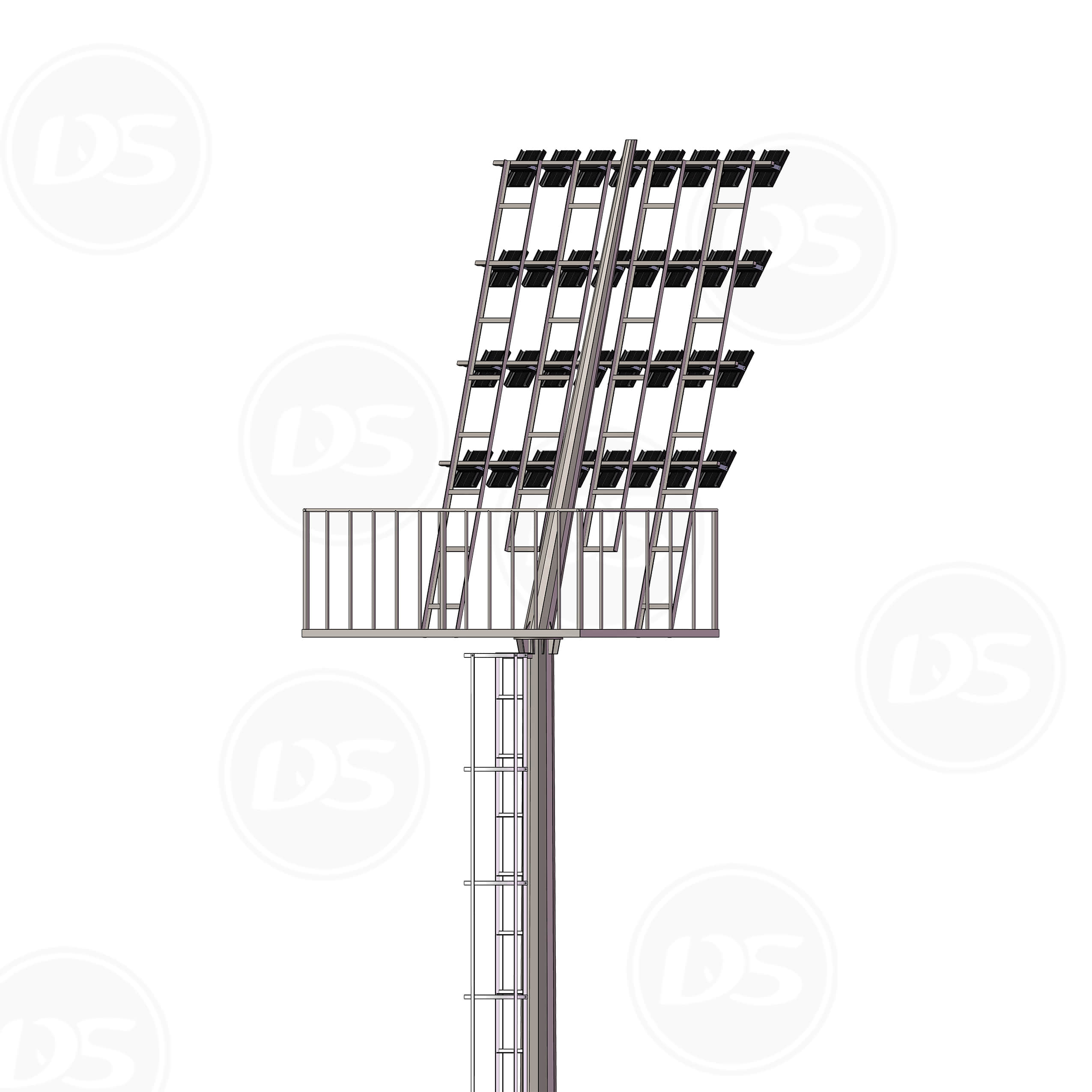
A high mast light pole is a tall outdoor lighting structure designed to illuminate large areas from a single installation point. It usually stands between 15 to 40 meters, depending on project requirements, and can support multiple luminaires at its top, often arranged in a circular or square configuration. They are ideal for environments that demand broad, uniform lighting coverage over expansive spaces.
High mast systems often feature optional raising and lowering mechanisms, letting maintenance crews handle repairs at ground level. This reduces the need for lifts or climbing equipment, which is safer and faster. The structure is usually made of Q235 steel, hot-dip galvanized for corrosion resistance, and sometimes coated with marine-grade paint for coastal or humid environments, extending service life to 30+ years.
High mast poles are designed not just to be tall. They balance structural strength, wind resistance, and luminaire arrangement, ensuring efficient lighting while handling environmental stresses like wind and rain. It’s why they are chosen over regular lights in complex or high-traffic areas.
The design priorities for high mast and regular lights differ significantly. High mast poles focus on wide coverage and fewer installations, while regular lights prioritize local illumination and simplicity. Height plays a huge role: taller poles mean broader light distribution, fewer shadows, and reduced number of fixtures. Regular poles, on the other hand, are easier to install, cheaper per unit, and better suited for linear layouts like streets or walkways.
Design and Purpose Comparison:
Coverage: High mast lights cover 5–10 times more area than a regular light, reducing installation density.
Fixture Arrangement: High mast uses multi-luminaire setups; regular lights often rely on single lamps.
Structural Requirements: High mast poles must resist higher wind loads, support heavier fixtures, and maintain stability. Regular lights face fewer environmental stresses.
Visual Overview of Differences:
Aspect | High Mast Light Pole | Regular Light Pole |
|---|---|---|
Height | 15–40 meters | 5–12 meters |
Luminaire Layout | Multiple, circular/square | Single, linear |
Structural Demand | Heavy-duty steel, wind-resistant | Lighter steel or aluminum |
Maintenance | Lifting system, safer | Requires ladder or bucket truck |
Area Efficiency | Covers wide open areas | Localized coverage |
High mast light poles are engineered to optimize illumination across large areas while reducing maintenance risks. Regular lights are designed for small-scale, low-risk environments. They serve different purposes but share the same goal: reliable outdoor lighting.
When evaluating outdoor lighting options for large projects, understanding the practical distinctions between high mast light poles and regular lights is crucial. Their differences are not only about height—they also affect coverage, structural requirements, maintenance, and long-term durability. Let’s break it down with concrete insights.
For large areas like airports, stadiums, or expansive parking lots, high mast light poles dramatically improve efficiency. Imagine trying to light a 5,000 m² lot with traditional streetlights—you’d need dozens of poles, complex wiring, and more maintenance points. A single 30-meter high mast pole with eight LED luminaires can cover the same area evenly, drastically reducing installation density.
To make this clearer, consider:
Area efficiency: High mast poles illuminate 4,000–10,000 m² per pole, meaning fewer poles are needed, less infrastructure is required, and long-term energy costs drop.
Lighting uniformity: Fewer poles result in minimal shadows, making walkways and roadways safer while maintaining visual comfort for drivers or pedestrians.
Energy output: Advanced LED luminaires on high mast poles provide high lumen output at lower wattage, enhancing energy efficiency compared to using multiple low-mounted lights.
Feature | High Mast Light Pole | Regular Light Pole |
|---|---|---|
Coverage Area | 4,000–10,000 m² per pole | 200–500 m² per pole |
Poles Required | Minimal | Many |
Shadow Reduction | Minimal | Noticeable |
Energy Efficiency | High (LED optimized) | Moderate |
Because of their height and weight, high mast light poles must withstand severe conditions, including strong winds and heavy fixtures. They are usually made from Q235 steel, hot-dip galvanized for long-term corrosion resistance, and can include marine-grade coatings for coastal or humid environments. Regular light poles, designed for lower heights, face fewer environmental challenges and often use lighter steel or aluminum.
Some key considerations include:
Strength and stability: High mast poles must resist wind speeds of 30–60 m/s while keeping the luminaires perfectly aligned. This makes structural integrity a top priority in their design.
Material quality: Strong steel, professional welding, and thick galvanization ensure durability, whereas regular poles prioritize cost-effectiveness over extreme environmental resilience.
Fixture support: Heavy LED clusters on high mast poles require precise engineering to prevent vibration or sagging, which is rarely a concern for low-mounted streetlights.
Maintenance can define the long-term usability of outdoor lighting. High mast systems often incorporate automatic lifting mechanisms, allowing technicians to lower fixtures safely to the ground without road closures or risky climbing. Regular lights, in contrast, rely on ladders or bucket trucks, which may disrupt traffic and increase labor risk.
To illustrate:
Ease of maintenance: High mast lifting systems enable ground-level inspection and lamp replacement, making routine checks faster and safer.
Safety advantages: Technicians avoid working at extreme heights, reducing the risk of accidents.
Operational continuity: Fewer maintenance interruptions mean lighting reliability is higher, especially in busy highways or industrial areas.
Durability is where the investment in high mast light poles truly pays off. With protective coatings, robust materials, and professional assembly, these poles can last 30+ years, while regular poles typically have 15–20 years of service life depending on exposure. Several factors influence longevity:
Material integrity: Q235 steel and high-quality galvanization resist corrosion far better than lighter metals used in low-mounted lights.
Environmental exposure: Coastal, humid, or polluted environments accelerate wear on regular poles; high mast poles can be customized to withstand these conditions.
Structural design: Professional welding reduces defects like pores or undercutting, ensuring stability even under wind and vibration stress.
Maintenance frequency: Less frequent maintenance due to higher durability further extends operational efficiency and reduces long-term costs.
Understanding where to deploy high mast light poles versus regular lights makes a huge difference in both cost and effectiveness. Large projects need careful planning, and the choice impacts safety, coverage, and long-term maintenance.
High mast light poles shine in areas where wide coverage is non-negotiable. They are perfect for spaces too large for conventional poles, offering even illumination and reduced shadow zones.
Large parking lots: They light thousands of square meters, improving visibility and safety for both vehicles and pedestrians.
Airports and runways: High mast poles ensure pilots, ground staff, and passengers benefit from consistent brightness over expansive surfaces.
Industrial zones and logistics yards: Heavy machinery and open layouts demand uniform lighting to prevent accidents and operational delays.
Highways and intersections: They minimize dark spots on multi-lane roads, keeping traffic safer during nighttime operations.
Feature | High Mast Light Pole | Why It Matters |
|---|---|---|
Coverage Area | 4,000–10,000 m² | Fewer poles, less wiring, fewer shadows |
Height | 15–40 meters | Optimal for wide illumination without multiple fixtures |
Maintenance | Lifting system for ground-level access | Safer, faster, fewer interruptions |
Ideal Use | Large open spaces | Airports, stadiums, ports, industrial areas |
In practice, deploying Dison high mast light poles can drastically reduce the number of poles needed while keeping brightness uniform. They support multiple luminaires, letting designers achieve precise coverage patterns even in complex layouts.
Regular lights excel in localized areas where smaller coverage is sufficient and lower cost is a priority. They’re ideal for linear paths, residential zones, or public spaces that don’t need huge light footprints.
Local streets and sidewalks: Provide targeted illumination for pedestrian and vehicle safety without over-lighting nearby properties.
Residential areas and parks: Comfortable lighting for recreation or walking paths, avoiding glare or wasted energy.
Small parking lots or community facilities: Covers essential areas efficiently without unnecessary infrastructure investment.
Budget-sensitive projects: Lower upfront cost makes them attractive when wide-area coverage isn’t required.
Choosing the right system often depends on balancing coverage needs, budget, and maintenance considerations. High mast light poles dominate in large, open areas where visibility and safety are critical. Regular lights are better suited to smaller, linear, or budget-conscious projects.
When planning outdoor lighting projects, the financial and operational implications of high mast light poles versus regular lights are often decisive. It’s not just about upfront cost; efficiency, maintenance, and lifespan all factor into long-term value.
Installing high mast light poles involves higher initial investment due to taller structures, stronger foundations, and professional-grade installation. The poles require careful engineering to handle multiple luminaires and wind loads, so upfront labor and material costs are significant.
High mast installation: Taller poles, reinforced foundations, and precise alignment mean the initial cost is higher, but fewer poles are needed overall, which reduces wiring, trenching, and civil work.
Regular light installation: Cheaper per pole and faster to install, but covering large areas may require many more units, increasing cumulative foundation and wiring costs.
Project perspective: Over large highways, airports, or stadiums, high mast light poles often provide better cost efficiency despite the initial expense.
Installation Factor | High Mast Light Pole | Regular Light |
|---|---|---|
Pole Height | 15–40 meters | 5–12 meters |
Foundation Cost | High | Low per pole but accumulates |
Installation Complexity | Professional crew required | Simple setup |
Number of Poles | Fewer | More for same coverage |
Energy consumption and performance vary greatly between the two lighting systems. High mast poles equipped with LED luminaires produce higher lumen output per fixture, allowing a single pole to illuminate large areas effectively. Regular lights may use less wattage per pole, but multiple units are often required to achieve similar coverage.
High mast efficiency: Fewer fixtures mean less total energy consumption per square meter, and advanced optics reduce wasted light.
Regular light efficiency: Works well in small, local zones but less energy-efficient when scaled up for large spaces.
Performance advantage: High mast poles provide uniform brightness, reduce shadowed areas, and enhance visibility, crucial for safety-critical environments like highways or industrial zones.
Maintenance plays a big role in long-term cost. High mast light poles often include automatic lifting systems, which allow fixtures to be serviced at ground level. This reduces labor risk, eliminates traffic disruptions, and speeds up routine inspections.
High mast maintenance: Safer and faster, fewer interruptions for traffic or operations, lower long-term labor costs.
Regular light maintenance: Requires ladders or bucket trucks, increases work time, and can disrupt traffic, especially in busy streets or large parking areas.
Operational advantage: For projects spanning thousands of square meters, high mast systems lower cumulative maintenance effort and reduce safety risks for technicians.
By considering installation cost, energy performance, and maintenance savings, high mast light poles often offer better long-term value for large-scale projects, while regular lights remain suitable for smaller, localized applications.
High mast light poles cover large areas efficiently, while regular lights suit smaller spaces. Dison’s high mast products offer strong steel structures, corrosion resistance, and optional lifting systems, reducing maintenance risks. They provide uniform illumination for highways, airports, and industrial zones, delivering long-term value and safety for diverse outdoor projects.
A: It is a tall outdoor lighting system for wide-area illumination, often used in highways and airports.
A: High mast poles cover larger areas with fewer fixtures, while regular lights suit localized spaces.
A: Dison poles offer durability, corrosion protection, and lifting systems for safer maintenance.
A: They are ideal for streets, parks, and residential areas where coverage needs are smaller.
A: They have higher upfront costs but save energy, reduce pole count, and lower long-term maintenance.