Views: 0 Author: Site Editor Publish Time: 2026-05-09 Origin: Site
Have you ever wondered why some outdoor areas are brightly lit while others have dark spots? The height of a high mast light pole plays a key role in this. In this article, we explore how to choose the right pole height, what factors affect it, and how it ensures safe, uniform lighting. You will learn practical tips for selecting poles that balance coverage, efficiency, and maintenance for any large outdoor project.
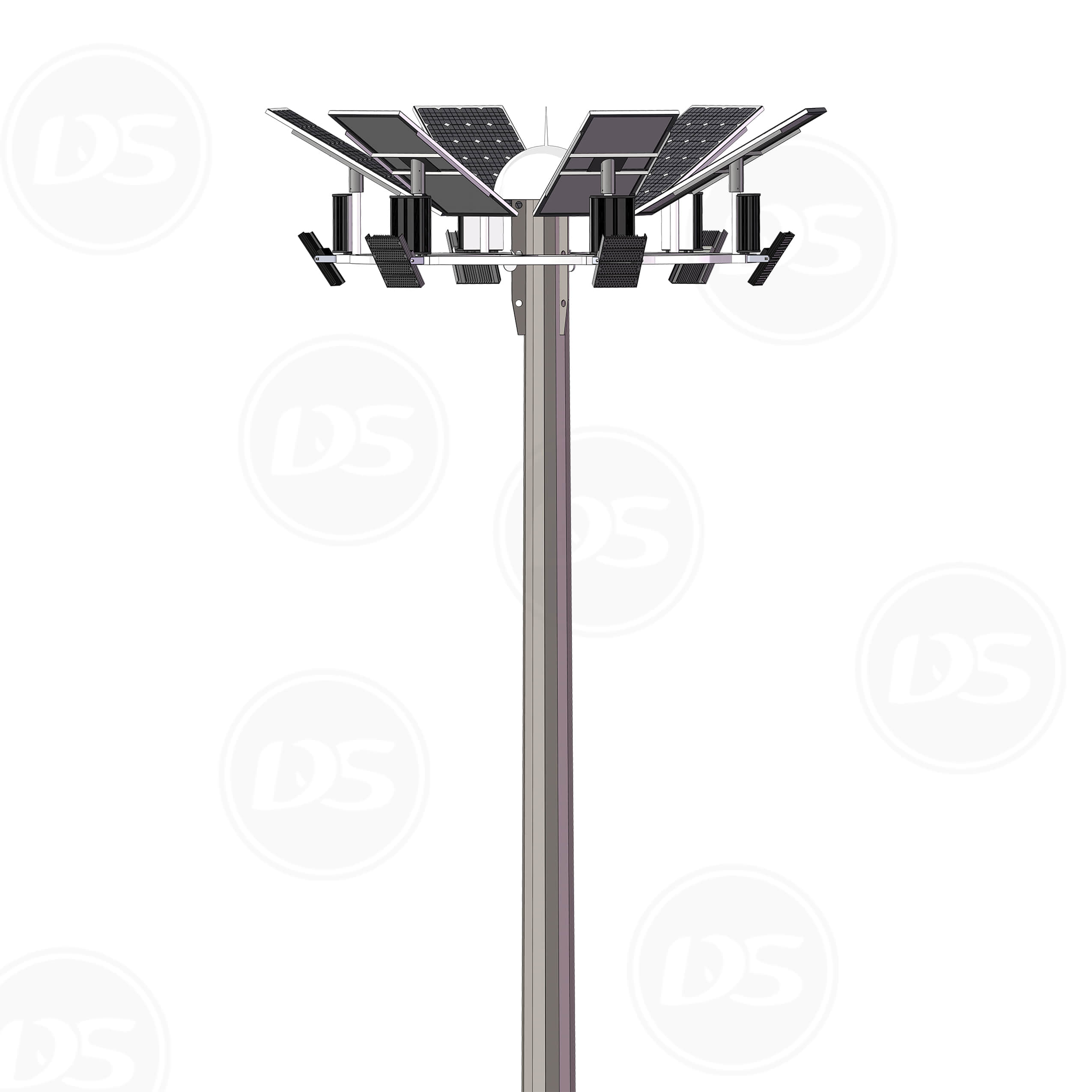
A high mast light pole is a tall vertical structure designed to illuminate large outdoor areas efficiently. Unlike regular street light poles, they are much taller and support multiple luminaires arranged on a circular or polygonal luminaire ring at the top. They often come with safety ladders or automatic lifting systems, making maintenance safer and more convenient.
Key components of a high mast light pole include:
Pole: The main steel structure, tapered for stability and wind resistance.
Luminaire ring: Holds multiple floodlights for wide coverage.
Ladders or lifting system: Allows maintenance at ground level or safe climbing access.
Foundation and flange: Anchors the pole firmly to the ground, designed for heavy loads.
These poles are widely used in airports, stadiums, ports, highways, and industrial zones. They are engineered to withstand high winds, corrosion, and harsh environmental conditions. Using high-quality steel like Q235, combined with hot-dip galvanization, ensures durability that can last decades. They are a smart investment for any large-area lighting project.
Selecting the right height is critical. It affects light coverage, uniformity, and safety. Dison high mast light poles, for example, offer a variety of options tailored to different applications. Common heights include 20M, 25M, 30M, and 40M, but custom solutions can reach 16–50M, depending on the site and lighting needs.
Several factors influence the choice of height: the total area to be illuminated, number of fixtures, desired lux levels, and structural limitations. Taller poles provide broader coverage but may require more robust foundations and lifting systems. Shorter poles reduce costs but may need additional units to achieve uniform lighting.
Typical height selection for different applications:
Application Type | Recommended Pole Height | Notes |
|---|---|---|
Medium parking lots | 20M–25M | Balanced coverage, easier installation |
Large industrial yards | 30M | Wide coverage, uniform illumination |
Ports, airports, stadiums | 35M–50M | Strong structural design, wind-resistant |
They are designed for flexibility. It is easy to adjust configurations for luminaire quantity, beam angles, and site geometry. Using a combination of steel strength, corrosion protection, and maintenance-friendly systems ensures that they perform reliably for years. Dison high mast light poles, in particular, offer optional lifting mechanisms so technicians can lower the luminaire ring for service safely at ground level.
Choosing the right height isn’t just about distance. It balances efficiency, safety, and long-term performance. The pole, materials, and environmental factors together determine how effectively a high mast light pole can illuminate a large space.
For smaller outdoor spaces, high mast light poles usually range from 20M to 25M. They are perfect for parking lots, compact industrial yards, and public squares where wide coverage is needed but extreme height is unnecessary. Using poles in this range keeps installation costs lower and simplifies maintenance.
Advantages of 20M–25M poles include:
Cost-effective: Fewer materials and simpler foundations reduce expenses.
Maintenance-friendly: Easier access via ladders or lifting systems.
Sufficient coverage: Multiple poles ensure uniform illumination without overdesign.
In these settings, designers often pair moderate-height poles with strategically placed luminaires to minimize dark spots and glare, improving safety for vehicles and pedestrians alike.
When covering larger industrial zones or transportation hubs, poles between 30M and 40M are more suitable. They provide extended reach and reduce the number of poles needed for uniform lighting. Typical sites include ports, container yards, large intersections, and highways.
Key considerations for 30M–40M high mast light poles:
Structural strength: Must withstand wind speeds and heavy luminaire loads.
Wind resistance: Taller poles are more exposed, so robust design is essential.
Coverage radius: Larger luminaire rings allow fewer poles while maintaining brightness.
Example layout for large areas:
Area Type | Pole Height | Number of Poles | Coverage Notes |
|---|---|---|---|
Port container yard | 35M | 4–6 | Wide light spread, minimal shadows |
Highway interchange | 30–40M | 2–4 | Uniform illumination along lanes |
These poles often use Q235 steel, hot-dip galvanization, and optional marine-grade coatings, ensuring durability in challenging industrial or coastal conditions.
For massive infrastructure projects, such as airports, stadiums, or major ports, 40M–50M high mast light poles are recommended. At this height, they provide maximum coverage while reducing the number of required poles.
Special requirements for very tall poles:
Advanced corrosion protection: Marine-grade coatings or additional galvanization.
Automatic lifting systems: Safe maintenance without scaffolding or cranes.
Structural reinforcement: Extra steel thickness or flanges to handle extreme wind loads.
These poles are essential for sports complexes, large open-air terminals, and critical industrial sites where lighting uniformity, safety, and long-term performance are non-negotiable. Proper design ensures each pole withstands harsh conditions while delivering effective, reliable illumination.
High mast light poles rely on materials engineered for strength and stability. Q235 steel or equivalent is commonly used, offering a balance between tensile strength and flexibility. The poles are often tapered, wider at the base and narrower at the top, allowing them to resist bending under wind loads. They are designed to handle wind speeds of 30–60 m/s, especially in coastal or high-wind areas, ensuring the structure remains secure and safe. Multiple sections may be welded together, creating a strong and stable column that supports heavy luminaire rings efficiently.
Key structural points:
Tapered pole design for load distribution.
Yield strength of at least 235 N/mm², tensile strength 375–500 MPa.
Reinforced flange and foundation for secure anchoring.
Designed for long-term stability in industrial and open spaces.
Environmental factors affect pole longevity. Hot-dip galvanization is standard, providing a zinc coating of at least 85 μm, which protects against rust and corrosion. For coastal or industrial sites, marine-grade coatings enhance durability further, allowing the poles to resist salt, humidity, and chemical exposure. Proper coating extends the service life, reduces maintenance, and keeps the structure visually intact over decades.
Protection comparison table:
Coating Type | Thickness / Specs | Suitable Environment | Lifespan Impact |
|---|---|---|---|
Standard hot-dip galvanization | ≥85 μm zinc coating | Urban and industrial areas | 25–30 years |
Marine-grade coating | Custom, enhanced zinc | Coastal, ports, heavy industry | 30–40 years |
Additional maintenance, such as periodic inspections and touch-up painting, ensures these protective layers remain effective over time.
Maintaining high mast light poles safely is crucial. Raising and lowering systems allow technicians to service luminaires from ground level, avoiding high-risk climbs. Manual ladders remain an option, though they are slower and require more safety precautions. Automatic lifting systems are more efficient, particularly for taller poles over 30M. They also reduce downtime and minimize the risk of injury during lamp replacement or routine inspections.
Benefits of lifting systems:
Ground-level maintenance for efficiency and safety.
Reduces need for scaffolding or cranes.
Enables routine inspection without affecting lighting operations.
Supports larger pole heights, 40–50M, commonly used in ports or stadiums.
The pole's site affects height and design choices. High wind zones, coastal humidity, or heavy rainfall require reinforced poles and protective coatings. Terrain is also a factor: flat areas allow more uniform pole spacing, while uneven terrain may require height adjustments. Local regulations may dictate minimum or maximum pole height, spacing, or luminaire intensity. Designers must consider these factors during planning to ensure both safety and performance.
Environmental considerations:
Wind, rain, and salt exposure.
Terrain variations and mounting foundations.
Compliance with municipal lighting standards and safety codes.
Site accessibility for maintenance and installation equipment.
Determining the correct high mast light pole height begins with understanding the area you want to illuminate and the required lux levels. It’s not just about tall poles; spacing, luminaire output, and beam angle all play a role. Simulation tools can model light distribution, helping identify the optimal height and layout for uniform coverage. These tools account for shadows, glare, and overlap, ensuring the site is evenly lit while minimizing energy waste. Designers often adjust pole height iteratively, balancing maximum illumination with structural limits and safety.
Steps for height calculation:
Measure site dimensions and surface reflectivity.
Define required lux levels per area type.
Select luminaire type and beam angle.
Run simulation to test uniformity and coverage.
Adjust pole height for optimal lighting efficiency.
A table example for small, medium, and large sites can help visualize height decisions:
Site Type | Area Size | Recommended Pole Height | Notes |
|---|---|---|---|
Small parking lot | <5,000 m² | 20–25M | Fewer poles, easier installation |
Medium industrial yard | 5,000–15,000 m² | 25–30M | Balanced coverage and cost |
Large stadium or port | >15,000 m² | 35–50M | Requires strong structural support |
Choosing taller high mast light poles can reduce the number of poles needed but may increase manufacturing and foundation costs. Shorter poles are cheaper upfront but could require more units, impacting installation and maintenance time. Safety is also a factor; taller poles need lifting systems and corrosion protection to handle environmental stress. Energy efficiency is affected too: properly spaced taller poles may reduce energy usage by lowering the total number of luminaires.
Key considerations:
Budget vs. coverage: Fewer taller poles or more shorter poles.
Structural safety: Wind load and material strength for each height.
Maintenance efficiency: Lifting systems reduce labor risk and downtime.
Energy consumption: Optimal pole layout can lower total wattage needed.
Designers often combine these factors, using simulations and manufacturer recommendations to select the best height for both performance and cost-effectiveness.
Dison high mast light poles range from 20M to 50M, offering strong steel construction, corrosion protection, and optional lifting systems. They ensure wide, uniform lighting for parking lots, ports, airports, and stadiums. Dison’s solutions combine safety, durability, and easy maintenance, delivering long-term value for large-area outdoor projects.
A: A high mast light pole is a tall structure for large-area illumination, providing uniform coverage for industrial, sports, and transport sites.
A: Select height based on area size, desired lux levels, wind load, and safety requirements to ensure efficient lighting.
A: Coatings like hot-dip galvanization protect poles from rust and environmental damage, extending lifespan in coastal or industrial areas.
A: Taller poles reduce the number of poles needed but increase foundation and material costs, balancing efficiency and budget.
A: Lifting systems allow lamps to be lowered safely to the ground, simplifying inspection, replacement, and routine maintenance.