Views: 0 Author: Site Editor Publish Time: 2026-05-09 Origin: Site
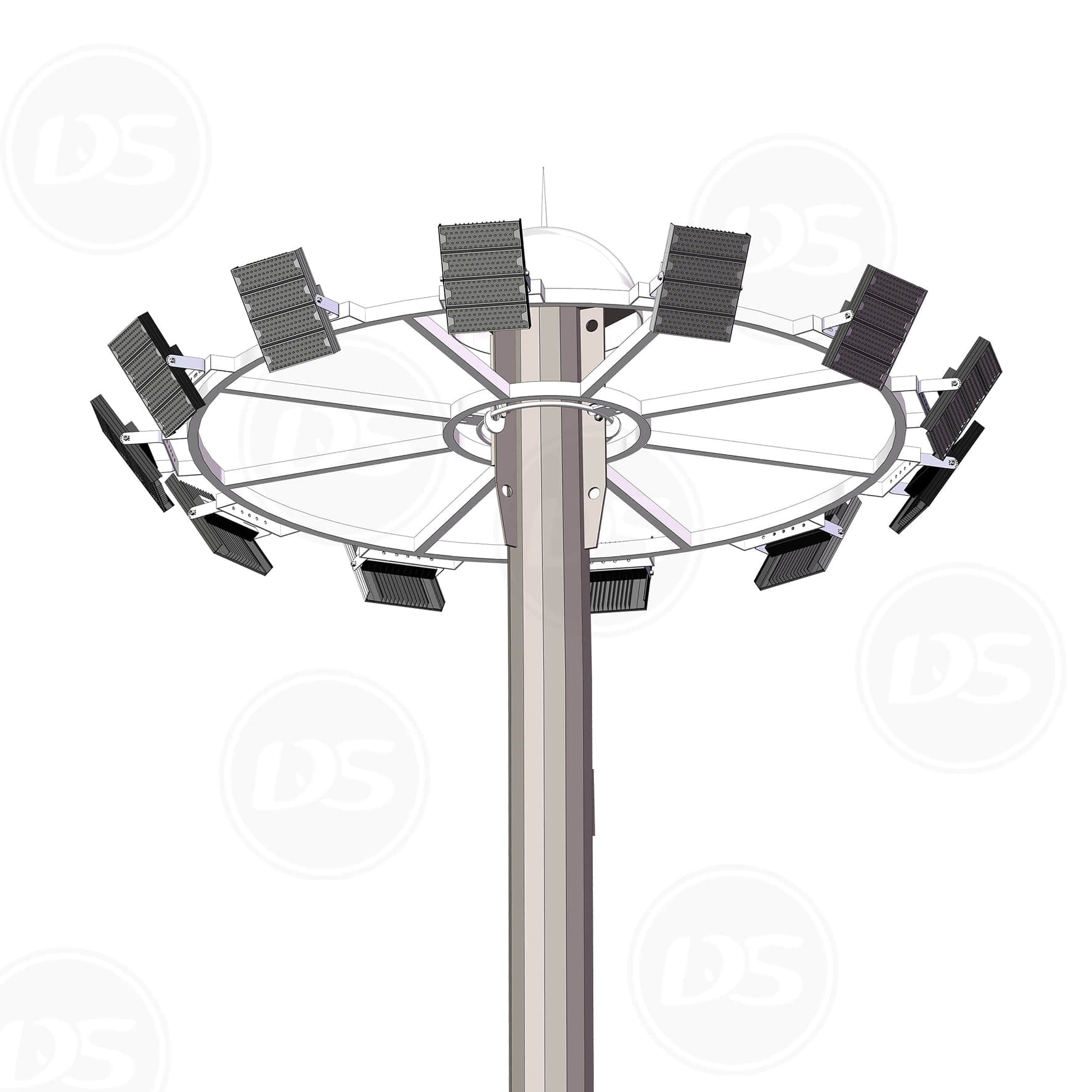
Have you ever wondered how large stadiums, ports, or highways stay brightly lit at night? High mast light poles provide powerful illumination across wide areas while improving safety and reducing maintenance. In this article, you will learn how these poles enhance visibility, save energy, and offer durable, easy-to-maintain solutions. We will explore their benefits, applications, and why choosing the right high mast light pole makes a difference for any large outdoor project.
High mast light poles transform large outdoor spaces into evenly lit, safer, and more organized areas. Instead of scattering multiple low poles across a site, you can centralize lighting on a few tall poles, freeing space for vehicles, pedestrians, and operations. It also reduces wiring complexity, foundation requirements, and installation time. When planning a project, it’s helpful to consider the advantages in a more concrete way:
Space optimization: A single high mast light pole can illuminate areas that would otherwise need several low poles, leaving open zones free for movement or storage.
Cost efficiency: Using fewer poles means less excavation, fewer electrical connections, and lower overall material costs without sacrificing brightness.
Installation convenience: They allow crews to focus resources on fewer high points rather than distributing labor across dozens of lower poles, which accelerates project timelines.
Shadow reduction: Centralized, elevated lighting minimizes dark corners created by obstacles, improving safety and visual comfort across wide areas.
Once the lights are mounted high, the entire scene changes. They aren’t just brighter—they help people see consistently across every corner of a space. This is crucial in parking lots, industrial yards, and intersections, where poor visibility can lead to accidents or operational delays. Consider how these advantages play out in daily use:
Accident prevention: Elevated lighting reduces dark patches that could hide pedestrians, vehicles, or equipment, helping lower the risk of collisions.
Enhanced monitoring: Security cameras and site personnel benefit from broad and uniform illumination, making it easier to spot potential hazards or unauthorized activity.
Operational confidence: Workers and drivers feel safer and can carry out tasks efficiently at night, boosting overall productivity in industrial or transport hubs.
By connecting illumination to both safety and workflow, high mast light poles provide more than just brightness—they create a safer, more functional environment.
High mast poles don’t just shine; they spread light evenly to every part of the area. This reduces glare, avoids dark spots, and ensures the environment feels visually balanced. It’s especially noticeable in large-scale applications like stadiums or ports, where consistent illumination impacts both perception and safety. To see this effect more clearly, look at how they perform across different project types:
Stadium lighting: Properly mounted poles ensure spectators, players, and staff experience even illumination, avoiding sudden bright or dark patches.
Parking lot coverage: Each section receives consistent brightness, making it easier for drivers to spot obstacles and pedestrians without straining their eyes.
Highway intersections: Poles positioned strategically spread light across multiple lanes, reducing glare and enhancing driver reaction time.
Energy efficiency: When combined with LED luminaires, high mast systems maintain uniformity while consuming less electricity, balancing environmental and operational goals.
Example of high mast coverage per application:
Application Area | Recommended Pole Height | Typical Luminaire Count | Coverage Benefit |
|---|---|---|---|
Stadium | 25–40 m | 4–12 floodlights | Balanced field illumination for players and spectators |
Parking lot | 20–30 m | 3–6 luminaires | Clear visibility for cars and pedestrians |
Highway intersection | 25–35 m | 6–8 luminaires | Uniform light across multiple lanes |
By integrating these systems, you get high-impact illumination, cost savings, and improved safety—all from fewer, smarter poles.
Choosing the right material is the foundation of a reliable high mast light pole. Tall poles must hold heavy luminaires without bending, twisting, or compromising safety over years of outdoor exposure. Using strong and flexible steel ensures stability while supporting multiple fixtures. For example, Dison high mast light poles employ Q235 steel, which balances toughness and ductility to handle both static weight and dynamic forces from wind.
When you think about durability, consider these aspects carefully:
Steel strength: The backbone of the pole relies on Q235 steel to resist bending under strong gusts, keeping luminaires secure even in open or exposed environments.
Load flexibility: Proper steel allows slight bending without cracks, preventing long-term structural damage under repeated stress.
Weld integrity: High-grade steel supports precise, defect-free welding, ensuring that flanges, joints, and ladders remain solid and safe throughout the pole’s lifespan.
These material choices make it possible to maintain multiple lighting fixtures and accessories while reducing structural failure risks over decades.
After selecting strong steel, protecting it against the elements is crucial. High mast light poles face rain, wind, humidity, coastal salt, and industrial pollution every day. Dison addresses this through hot-dip galvanization, forming a protective zinc layer that prevents rust, and optional marine-grade coating for extreme conditions.
Considering outdoor durability, here’s how these measures translate to real benefits:
Wind resistance: The poles are engineered to withstand winds above 30 m/s, keeping lights stable during storms or in exposed locations like ports, highways, and open yards.
Corrosion prevention: Galvanization plus marine-grade coatings guard against rust in humid, salty, or polluted air, ensuring structural and visual integrity.
Extended lifespan: The combination of strong materials and protective coating extends service life beyond 30 years, reducing replacement frequency and maintenance costs.
By addressing environmental stress, high mast light poles continue providing safe and reliable illumination, even in challenging locations.
Durability is also about adhering to recognized benchmarks. High mast light poles must comply with ISO, CE, RoHS, and IEC standards, which ensure structural safety, electrical reliability, and environmental performance. For customers, this translates to peace of mind during installation and long-term operation.
Consider how standards influence quality and trust:
Structural testing: Poles undergo rigorous load and wind-resistance testing, confirming they can handle extreme conditions without bending or tipping.
Electrical safety: Compliance with IEC and RoHS guarantees safe operation for luminaires and integrated electrical components.
Project approvals: Meeting local and international standards simplifies permitting and ensures acceptance in public infrastructure or commercial projects.
Following these standards helps guarantee poles that remain reliable, safe, and effective over decades, giving large-area projects the confidence to rely on high mast lighting.
High mast light poles often reach heights that make routine maintenance tricky. To make it easier, they can include automatic lifting systems, allowing the luminaire ring to lower safely to the ground. This reduces risks for maintenance crews and ensures inspection or replacement can happen quickly.
Imagine a stadium or airport: workers don’t need cranes or lifts to reach every light. Some key advantages include:
Safety improvement: Technicians handle lights at ground level instead of climbing poles, reducing fall hazards.
Time-saving operation: Raising and lowering mechanisms cut maintenance time dramatically, allowing more frequent inspections.
Flexible control: Systems often come with manual or remote controls, so it’s easy to adjust the height based on task needs.
In practice, these systems help projects continue running smoothly while keeping worker safety a top priority.
High mast light poles are built to last decades, and combining them with LED or solar-powered luminaires can further cut operational costs. They require less frequent lamp replacements and consume far less energy than traditional fixtures.
Consider the real benefits for a large parking lot or port:
Energy savings: LEDs paired with high mast poles reduce electricity bills, especially when used over long nightly hours.
Durability benefits: Corrosion-resistant poles maintain structural integrity even in coastal, industrial, or wet environments.
Long-term investment: Fewer replacements and repairs mean overall maintenance budgets shrink over the pole’s 30+ year lifespan.
Maintenance advantages comparison:
Feature | Traditional Pole Lighting | High Mast Light Pole (LED/Solar) |
|---|---|---|
Energy use | High, continuous | Lower, efficient LED or solar-powered |
Lamp replacement | Frequent | Minimal, long-lasting LEDs |
Pole longevity | 15–20 years | 30+ years with corrosion resistance |
Maintenance safety | Risky climbs | Ground-level operations with lifting system |
This combination of technology and design ensures projects run efficiently while minimizing downtime and cost.
Routine maintenance can still be challenging if the system is not modular or accessible. High mast poles address this by integrating features that allow easy access and component replacement. Technicians can inspect luminaire rings, cabling, and mounting hardware without complex equipment, making scheduled checks simpler and faster.
Key points include:
Modular design: Components such as light engines, wiring, and control boxes are easy to detach and replace on-site.
Quick inspections: Regular safety and performance checks can be done without cranes or specialized lifts.
Operational continuity: Reduces downtime for commercial, industrial, or public spaces because maintenance is fast and less intrusive.
By combining these design elements, high mast light poles provide safer, smarter, and more cost-effective maintenance solutions across a variety of large-area projects.
High mast light poles are not limited to one type of environment—they shine in large industrial and commercial settings where wide coverage is essential. Ports, airports, warehouses, and logistics hubs benefit from the elevated lighting that minimizes shadows and improves safety for staff and vehicles. It’s more than brightness; it’s about operational efficiency and visual clarity. For instance, in a busy port, high mast poles allow crane operators and ground staff to see clearly across vast container yards.
Some practical advantages include:
Enhanced operational visibility: Workers, forklifts, and vehicles move safely under uniform light, reducing accidents.
Reduced infrastructure clutter: Fewer poles mean open layouts for logistics and storage operations.
Improved security: Elevated light covers larger zones, supporting surveillance and deterring unauthorized access.
Industrial application example:
Location Type | Recommended Pole Height | Typical Luminaires | Key Benefit |
|---|---|---|---|
Port | 30–40 m | 6–12 | Full yard coverage, safer operations |
Airport apron | 25–35 m | 8–10 | Clear visibility for aircraft and ground vehicles |
Warehouse yard | 20–30 m | 4–6 | Efficient movement and reduced shadow areas |
These solutions allow commercial and industrial facilities to operate efficiently after dark while maintaining safety and productivity.
Cities and public spaces demand reliable, high-coverage lighting for streets, intersections, parking lots, and stadiums. High mast light poles are perfect for municipal projects because a single pole illuminates areas that otherwise require multiple low-height lights. This simplifies planning, reduces installation costs, and creates safer urban environments.
Consider these benefits:
Traffic safety: Uniform illumination across highways and intersections helps reduce accidents and improves visibility for drivers.
Public convenience: Well-lit parking lots and pedestrian zones create safer, more inviting spaces.
Event management: Stadiums and sports complexes can host nighttime events efficiently, thanks to evenly distributed high mast lighting.
For off-grid locations or projects aiming to reduce energy costs, solar-powered high mast light poles are an ideal solution. They integrate renewable energy, battery storage, and LED luminaires to provide reliable lighting without constant grid access. This is particularly useful in remote ports, construction sites, or rural highways.
Key advantages include:
Renewable energy integration: Solar panels and efficient batteries power the system for long durations, even during cloudy days.
Operational independence: Projects in remote areas avoid extensive electrical infrastructure and reduce grid dependency.
Sustainability: Lower energy consumption and minimal environmental impact make solar high mast poles an eco-friendly choice.
Maintenance-friendly design: Many solar high mast poles include automatic lifting systems, allowing inspection and lamp replacement without cranes or lifts.
By combining industrial strength, municipal reliability, and energy-efficient technology, high mast light poles provide flexible lighting solutions for virtually any large-area project.
Dison high mast light poles provide wide coverage, uniform illumination, and enhanced safety. Their durable steel construction, corrosion protection, and optional lifting systems simplify maintenance and extend service life. These versatile solutions suit industrial, commercial, and municipal projects while supporting energy-efficient LED or solar lighting. Dison ensures reliable performance and operational efficiency for large-area outdoor spaces.
A: A high mast light pole is a tall outdoor lighting system designed for large-area illumination, providing broad coverage and safety.
A: They often include automatic lifting systems, allowing inspection and lamp replacement at ground level safely.
A: LED and solar options reduce energy costs, extend lamp life, and lower long-term maintenance for large areas.
A: They are used in airports, ports, highways, stadiums, parking lots, and industrial yards for uniform lighting.
A: Strong Q235 steel, hot-dip galvanization, corrosion protection, and versatile designs ensure durability and operational efficiency.