Views: 0 Author: Site Editor Publish Time: 2026-10-14 Origin: Site
Grid-tied lighting infrastructure brings heavy logistical baggage. You have to trench through existing hardscapes, run miles of underground copper cabling, and wait months for utility connection approvals. These roadblocks destroy project timelines and inflate site development budgets. Off-grid alternatives bypass these hurdles entirely. Yet, many facility managers and urban planners still doubt their reliability. They question if a standalone system can survive harsh winters, how fast the batteries degrade, and whether the light output meets strict municipal standards.
We evaluate modern off-grid illumination technology from a strict engineering perspective. We look at component lifespans, failure rates, and field mechanics to see how these systems actually perform on site. You will see how upgrades in photovoltaic efficiency, battery chemistry, and smart controllers solve old performance problems. The following sections break down the technical realities of deploying a solar street light, offering actionable insights for designing, specifying, and maintaining off-grid illumination networks.
Reliability is heavily dependent on geographic sizing: A solar street light will only perform reliably if the solar array and battery capacity are engineered for the specific location's worst-case winter insolation data (autonomy days).
Battery chemistry dictates long-term ROI: Modern LiFePO4 (Lithium Iron Phosphate) batteries have fundamentally changed the maintenance math, offering 5 to 8-year lifespans compared to legacy lead-acid systems.
Upfront costs are offset by installation savings: While the per-pole hardware cost is higher, eliminating trenching, wiring, and grid-connection fees often makes solar lighting cheaper on day one for new developments.
Smart controllers are the operational brain: Adaptive dimming profiles (e.g., reducing output to 30% during low-traffic hours) are critical for preserving battery life and ensuring continuous operation through multi-day weather events.
Alignment with ESG initiatives: Beyond cost savings, transitioning to off-grid solar street lights provides immediate, measurable progress toward municipal and corporate carbon reduction goals.
Table of Contents
Understanding the field performance of off-grid illumination requires examining the individual solid-state components. A modern system operates as an independent microgrid. It generates, regulates, stores, and deploys electrical energy without external inputs. The reliability of this microgrid depends entirely on the quality and integration of its core parts.
Solar street lights use photovoltaic panels to convert sunlight into electricity. High-efficiency monocrystalline panels are widely used because they generate more power within a limited installation area. Actual energy output depends on sunlight intensity, temperature, shading, and panel orientation. Proper positioning helps improve charging efficiency and winter performance.
Panel Type | Typical Efficiency | Main Advantage |
|---|---|---|
Monocrystalline | 20%–24% | Higher power output per unit area |
Polycrystalline | 15%–17% | Generally lower initial cost |
Explore Dison's Solar Street Light solutions for different outdoor lighting requirements.
Solar street light charge controllers regulate electricity flowing from the solar panel to the battery. Maximum Power Point Tracking (MPPT) controllers optimize energy harvesting under changing sunlight conditions and can improve charging efficiency compared with basic PWM controllers. This helps maintain battery performance during cloudy weather and periods of reduced solar radiation.
LiFePO4 batteries are commonly used in modern solar street lighting systems because of their long cycle life, thermal stability, and usable energy capacity. Battery performance depends on depth of discharge, temperature, and charging conditions. Proper battery sizing and management help maintain reliable nighttime operation, particularly during winter or extended cloudy periods.
High-efficiency LED solar street lights deliver strong illumination while minimizing energy consumption. Suitable optical designs direct light toward roads, pathways, and public spaces, reducing unnecessary glare and light spill. Buyers should evaluate luminous efficacy, beam distribution, and mounting height to achieve the required lighting performance.
Explore Dison's All-in-One Solar Street Lights for integrated LED lighting solutions.
The most common objection to off-grid lighting is the assumption that systems will fail during prolonged periods of bad weather. Evaluating actual field performance requires looking past anecdotal failures of undersized residential units. We must examine how commercial systems are engineered for worst-case scenarios.
A prevalent misconception is that off-grid systems suffer from high failure rates. The core solid-state components feature exceptionally low failure rates. Legacy high-pressure sodium bulbs burn out and grid ballasts fail due to voltage spikes. Solid-state electronics degrade very slowly over decades. When a commercial solar street light fails, it is rarely a component malfunction. It is almost always a result of improper system sizing or poor location assessment during the design phase.
Solar street light autonomy refers to the number of nights a lighting system can operate without solar charging. In cloudy or snowy regions, projects may require 3–5 days of backup power, depending on local conditions. Engineers calculate battery capacity and solar panel wattage based on daily energy consumption, winter sunlight availability, and required lighting hours to ensure reliable performance.
Solar LED street lights should meet applicable roadway and public lighting requirements for brightness, uniformity, and glare control. Lighting designers use photometric simulations and IES files to determine suitable pole spacing, mounting heights, and light distribution. Proper system design helps maintain consistent illumination across roads, intersections, and parking areas. Explore Dison's Solar Street Light solutions for different outdoor applications.
Smart solar street lights use programmable dimming and motion sensors to reduce energy consumption. Fixtures can operate at higher brightness during busy hours and automatically dim when traffic decreases. PIR or microwave sensors increase illumination when movement is detected, helping extend battery autonomy while maintaining visibility. Learn more about Dison's Solar Street Lights with IoT Systems for intelligent lighting management.
Solar street lights are available in two main configurations: all-in-one integrated systems and split systems. Each offers different advantages in installation, energy storage, and solar panel positioning. Choosing the right design depends on project size, lighting requirements, and local sunlight conditions.
All-in-One solar street lights combine solar panels, batteries, LED fixtures, and controllers into a compact unit. Their integrated design reduces external wiring and simplifies installation, making them suitable for parks, pathways, residential streets, and commercial areas. However, solar panel positioning and battery capacity may be less flexible than in split systems.
Explore Dison's All-in-One Solar Street Lights for different outdoor lighting applications.
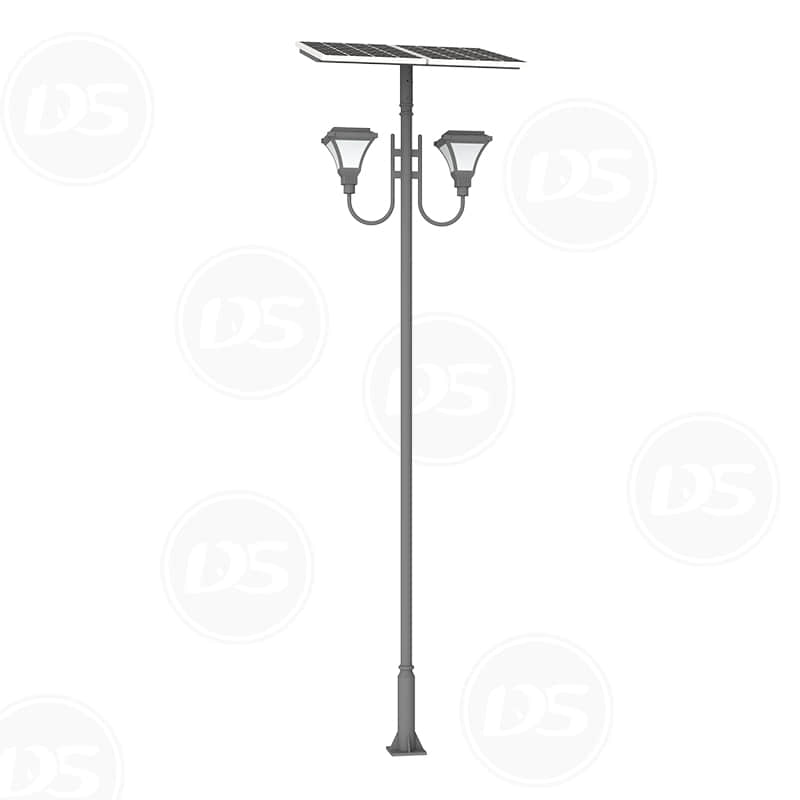
Split solar street lighting systems use separately mounted solar panels, LED fixtures, and battery storage. This configuration provides greater flexibility in panel orientation and energy storage capacity, making it suitable for wider roads, industrial areas, and locations with limited sunlight. However, installation generally requires more components and wiring.
Feature | All-in-One Systems | Split Systems |
|---|---|---|
Installation | Faster, fewer connections | More assembly and wiring |
Solar Panel Adjustment | Usually limited | More flexible |
Battery Capacity | Restricted by integrated design | Supports larger configurations |
Maintenance | Compact, integrated components | Separate component access |
Best Applications | Parks, pathways, parking lots | Highways, industrial facilities |
Installation Space | Compact | Requires more mounting space |
Off-grid solar street lighting reduces dependence on conventional electricity infrastructure while supporting energy savings and flexible outdoor installation. Long-term benefits include lower grid electricity expenses, reliable independent operation, and reduced environmental impact.
Solar street light maintenance primarily involves inspecting solar panels, batteries, LED modules, and controllers. LEDs typically require fewer replacements than traditional lighting sources, while batteries may need replacement earlier than other components. Regular cleaning and inspections help maintain charging efficiency and extend system reliability.
Off-grid solar street lights generate and store electricity locally, allowing them to operate independently of the utility grid. This eliminates routine grid electricity purchases and supports illumination during power outages, provided sufficient battery energy is available. Explore Dison's Solar Street Light solutions for different project requirements.
Solar-powered LED lighting supports sustainability initiatives by reducing grid electricity consumption and associated operational emissions. Off-grid installation may also reduce underground cabling and excavation. Actual environmental benefits depend on system performance, manufacturing impacts, battery replacement, and local electricity conditions.
Successful solar street light projects require proper site assessment, battery selection, and supplier evaluation. Key risks include insufficient sunlight, extreme temperatures, and unrealistic performance specifications.
Solar street light performance depends on sunlight availability, panel orientation, and seasonal weather conditions. Shadows from trees or buildings can reduce charging efficiency, particularly during winter. Conducting a site assessment helps determine suitable installation locations and solar panel capacity.
LiFePO4 solar street light batteries offer good cycle life and thermal stability, but extreme temperatures can affect performance. High heat accelerates aging, while low temperatures reduce available capacity and may restrict charging. Suitable battery management systems, temperature protection, and enclosure designs help improve reliability.
Solar street light suppliers should provide clear specifications for solar panel wattage, battery capacity, LED output, and expected operating hours. Buyers should request photometric data, lighting distribution files, and site-specific autonomy calculations to verify system performance before purchasing.
To ensure your off-grid lighting project operates flawlessly year-round, execute the following steps before finalizing any procurement decisions:
Request a localized photometric layout from your vendor to guarantee the system meets all applicable IESNA illumination and uniformity standards for your specific site.
Demand a detailed autonomy calculation based on your exact geographic coordinates and worst-case winter weather data to verify battery sizing.
Conduct a thorough physical shade analysis of the installation site, accounting for future vegetation growth and winter sun angles.
Initiate a small-scale pilot program to verify real-world performance, sensor responsiveness, and battery resilience before committing to a massive infrastructure rollout.
A: Modern systems utilize Lithium Iron Phosphate (LiFePO4) batteries, which typically last between 5 to 8 years under normal operating conditions. This is a significant improvement over legacy lead-acid batteries, which usually require replacement every 2 to 3 years. The exact lifespan depends heavily on the daily Depth of Discharge (DoD) and the ambient temperature of the installation site.
A: Yes, properly engineered systems operate reliably through winter and cloudy weather. This is achieved by sizing the battery and solar panel for the location's specific autonomy days. This ensures enough energy is stored to power the light for 3 to 5 consecutive days without direct sunlight. MPPT controllers efficiently harvest ambient light even under heavy cloud cover.
A: Absolutely. While compact all-in-one units are best for pathways, split-system architectures can power high-output LED fixtures. By utilizing large, independently adjustable solar arrays and massive battery banks, these systems easily generate the high lumen output required to meet strict Department of Transportation (DOT) highway illumination and uniformity standards.
A: The primary disadvantage is the strict requirement for unshaded, direct sunlight exposure. They cannot be installed under dense tree canopies or in the permanent shadow of tall buildings. Additionally, the physical size of the solar panels and battery enclosures creates a larger visual footprint compared to traditional grid-tied light poles.
A: Routine maintenance is minimal. Because LED modules have exceptionally low failure rates, there are zero routine bulb changes required. Maintenance generally consists of occasional visual inspections and, in highly dusty or arid environments, wiping down the solar panels to ensure maximum light transmittance. Battery and driver replacements are only needed every 7 to 10 years.
A: Extreme heat can accelerate battery degradation over time, while extreme cold temporarily increases internal resistance, reducing the battery's available capacity. To combat this, engineers use thermally stable LiFePO4 batteries. In severe climates, they bury the battery banks below the frost line or use ventilated, reflective enclosures to maintain optimal operating temperatures.