Views: 0 Author: Site Editor Publish Time: 2026-10-14 Origin: Site
The modernization of municipal and commercial infrastructure is shifting away from centralized, grid-dependent systems toward autonomous energy assets. Facility managers, urban planners, and developers face escalating grid electricity rates, prohibitive trenching costs for new site developments, and stringent regulatory mandates to reduce carbon footprints without compromising public safety. Transitioning to a solar street light network requires moving beyond surface-level green marketing. Decision-makers must rigorously evaluate the financial trade-offs, operational autonomy, system architectures, and long-term maintenance realities to justify the initial capital expenditure against long-term operational savings. We will break down the engineering realities, site assessment protocols, and hardware specifications needed to deploy these systems effectively in the field. You need hard data to make informed procurement choices. This guide provides the technical framework to assess off-grid lighting viability for your next commercial or municipal project.
Financial Restructuring: A solar street light shifts lighting costs from a perpetual operational expense (grid power) to a predictable, one-time capital investment, often achieving ROI within 3 to 5 years.
Infrastructure Autonomy: Off-grid operation ensures 100% lighting continuity during grid failures, brownouts, or extreme weather events, directly enhancing community security and liability mitigation.
Accelerated Deployment: By eliminating the need for trenching, cabling, and utility grid connections, solar lighting significantly accelerates project timelines and minimizes site disruption.
Risk Mitigation: Successful deployment requires careful geographic shading analysis, architectural selection (All-in-One vs. Split), and battery chemistry selection to prevent premature system degradation.
Table of Contents
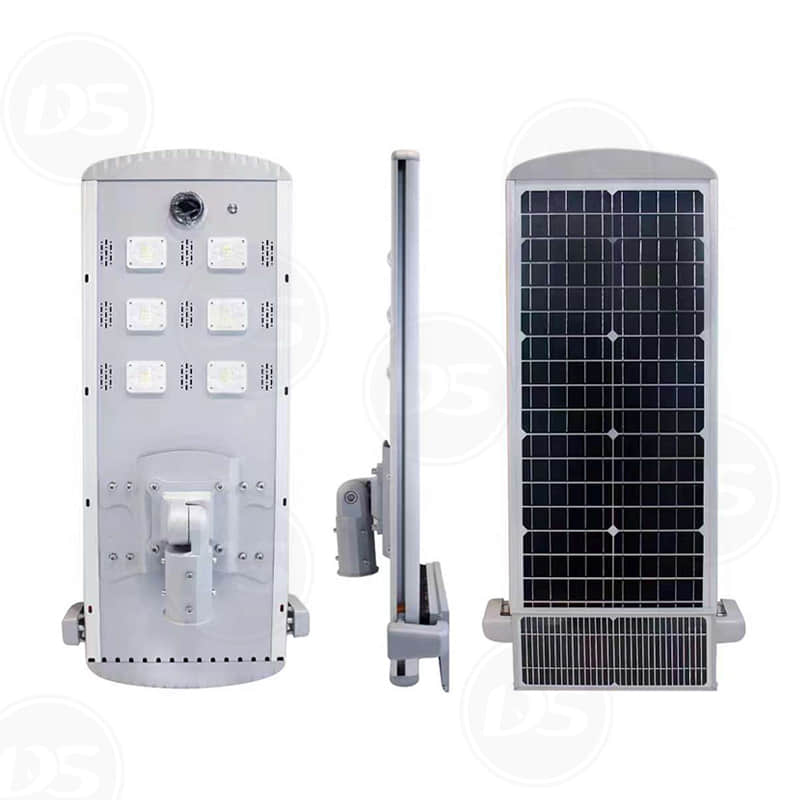
All-in-One solar street lights integrate the solar panel, LED fixture, battery, and controller into a compact unit. This design simplifies installation, reduces external wiring, and provides a modern appearance. They are suitable for parking lots, pathways, and commercial areas. However, integrated panel orientation requires careful planning to balance solar charging and lighting coverage. Explore Dison's All-in-One Solar Street Lights for available configurations.
Split solar street lighting systems separate the solar panel, battery, and LED fixture, allowing more flexible component positioning and capacity selection. Independent panel adjustment can improve solar energy collection, while larger external batteries support demanding lighting requirements. These systems are suitable for highways, industrial facilities, and locations with limited winter sunlight.
Feature | All-in-One Systems | Split Systems |
|---|---|---|
Installation | Faster, fewer external connections | More components and wiring |
Solar Panel Position | Usually integrated with fixture | Independently adjustable |
Battery Capacity | Limited by integrated design | More flexible configuration |
Maintenance | Compact but elevated components | Separate component access |
Best Applications | Pathways, parking lots, campuses | Highways, industrial areas, remote sites |
Solar street light costs include equipment, installation, battery maintenance, and long-term operating expenses. Although solar systems may require higher initial hardware investment, they can reduce electrical infrastructure costs and eliminate routine grid electricity purchases.
Off-grid solar street lights operate without underground power cables or utility grid connections, reducing trenching, wiring, and related construction expenses. This makes them especially suitable for remote roads, new developments, and locations with difficult underground conditions. Explore Dison's Solar Street Light solutions for different outdoor lighting projects.
Solar-powered street lighting generates and stores electricity locally, eliminating routine grid electricity purchases during normal off-grid operation. This helps municipalities and businesses reduce utility expenses and improve long-term budget predictability. However, battery replacement, cleaning, inspections, and occasional component repairs remain part of operating costs.
Solar street light ROI depends on equipment pricing, installation savings, local electricity rates, solar conditions, and maintenance expenses. Although solar systems may have higher initial hardware costs, reduced trenching and electricity expenses can improve long-term value. Buyers should calculate the payback period using project-specific costs rather than assuming a fixed return timeline.
Off-grid solar street lights operate independently of the electrical grid, providing reliable outdoor illumination for roads, parks, and remote locations. Integrated solar panels, batteries, and LED fixtures reduce dependence on conventional power infrastructure and support flexible installation. Explore Dison's all-in-one solar street lights for different outdoor lighting applications.
Solar-powered street lights continue operating during grid outages when sufficient battery energy is available. Their independent power systems help maintain lighting in remote communities, emergency access routes, and public spaces. Decentralized installations also reduce the risk of a single electrical failure affecting an entire lighting network.
Smart solar street lighting uses motion sensors, programmable dimming, and optional IoT controls to optimize energy consumption. Fixtures can reduce brightness during low-traffic periods and increase output when movement is detected. These features help conserve battery power and improve lighting efficiency. Explore Dison's solar street lights with IoT systems for intelligent lighting applications.
Solar LED street lighting improves nighttime visibility for pedestrians, cyclists, and drivers. Proper illumination and optical distribution help reduce dark areas and unwanted glare. These systems are particularly useful for parks, residential roads, parking areas, and locations without convenient grid access.
Solar street lighting systems generate electricity from sunlight, reducing grid electricity consumption and supporting sustainable infrastructure development. Their environmental benefits depend on solar performance, battery lifespan, manufacturing impacts, and responsible end-of-life management.
Solar-powered LED street lights help municipalities reduce reliance on grid electricity and support carbon reduction strategies. Renewable energy generation and efficient LED technology can lower operational emissions, although actual carbon savings depend on local electricity sources and system performance.
Off-grid solar lighting installation often requires less underground electrical cabling than conventional street lighting. Reduced trenching can help protect existing landscaping, limit excavation, and simplify installation in parks, rural roads, and environmentally sensitive locations.
Dark Sky-friendly solar street lights use suitable LED optics, shielding, and directional illumination to reduce unnecessary light spill and glare. Proper fixture selection and installation angles help limit light pollution and support applicable local outdoor lighting regulations.
Solar street light maintenance focuses on solar panel cleanliness, battery condition, LED performance, and control system reliability. Regular inspections and appropriate component selection help maintain consistent illumination and reduce unexpected service costs.
LED solar street lights generally use long-life LED modules and rechargeable batteries with different service lifespans. Battery replacement may be required before the LED module or solar panel reaches the end of its useful life. Actual replacement intervals depend on battery chemistry, charging cycles, temperature, and operating conditions.
Self-cleaning solar street lights help reduce dust accumulation on photovoltaic panels, while compatible remote monitoring systems can track battery and lighting performance. These features can simplify maintenance in demanding outdoor environments. Dison's DS-AIO6 self-cleaning solar street light is designed for dusty and desert environments.
Solar street lighting projects require careful evaluation of sunlight availability, battery capacity, environmental conditions, and installation security. Proper system sizing and component selection help improve reliability and reduce long-term operating risks.
Solar street light performance depends on local solar radiation, seasonal weather, panel orientation, and shading. Buildings, trees, and nearby structures can reduce charging efficiency. Buyers should assess site conditions and select appropriate solar panel and battery capacities to maintain the required lighting duration.
Solar street light batteries are sensitive to extreme temperatures. Cold weather can reduce available capacity, while excessive heat accelerates battery aging. LiFePO4 batteries are commonly used for their cycle life and thermal stability, but suitable temperature protection and charging management remain important for long-term reliability.
Anti-theft solar street lighting can incorporate elevated mounting, tamper-resistant fasteners, reinforced enclosures, and protected battery compartments. These features help reduce vandalism and unauthorized component removal. Dison's integrated solar street light designs also reduce exposed external components and simplify installation.
Deploying autonomous lighting infrastructure demands strategic planning and precise execution. To ensure optimal performance and long-term reliability, follow these actionable steps:
Conduct a comprehensive site shading analysis to verify adequate peak sun hours before finalizing pole locations.
Select battery chemistries specifically rated for your local temperature extremes to prevent premature cell degradation.
Implement smart controllers with adaptive dimming profiles to maximize energy reserves during prolonged inclement weather.
Standardize fixture designs and battery form factors across your facility to simplify future maintenance and procurement.
A: High-quality Lithium Iron Phosphate batteries generally last between seven and ten years, depending on the depth of discharge and local climate conditions. Extreme heat can shorten this lifespan, making proper thermal management essential.
A: Yes. Systems are engineered with specific autonomy days. They store enough reserve power in the battery bank to operate the light for three to five consecutive days without direct sunlight.
A: All-in-one systems integrate the panel, light, and battery into a single housing for fast installation. Split systems separate these components, allowing for larger batteries and independent panel aiming.
A: Yes. Many autonomous fixtures utilize standard slip fitter or trunnion mounts designed to attach directly to existing tenons, allowing you to reuse current pole infrastructure.
A: Yes, provided the system uses insulated battery enclosures or buries the battery box below the frost line. You must also select battery chemistries rated for sub-zero charging and discharging.
A: Motion sensors allow the light to operate at a lower brightness when the area is empty, conserving battery power. The light instantly switches to full brightness when movement is detected.