Views: 0 Author: Site Editor Publish Time: 2026-08-10 Origin: Site
Infrastructure investments demand predictable lifespans. Yet, the operational reality of exterior lighting often diverges from manufacturer claims. Premature structural failure of a street light pole introduces severe liability risks. It disrupts public safety and drastically inflates maintenance budgets through emergency replacements. Determining the true life expectancy requires separating the structural support from the luminaire. You must evaluate material science against local environmental stressors. You also need to implement strict installation and maintenance protocols. This guide provides a technical framework for evaluating structural longevity. We will help you make data-backed procurement decisions based on real-world field data.
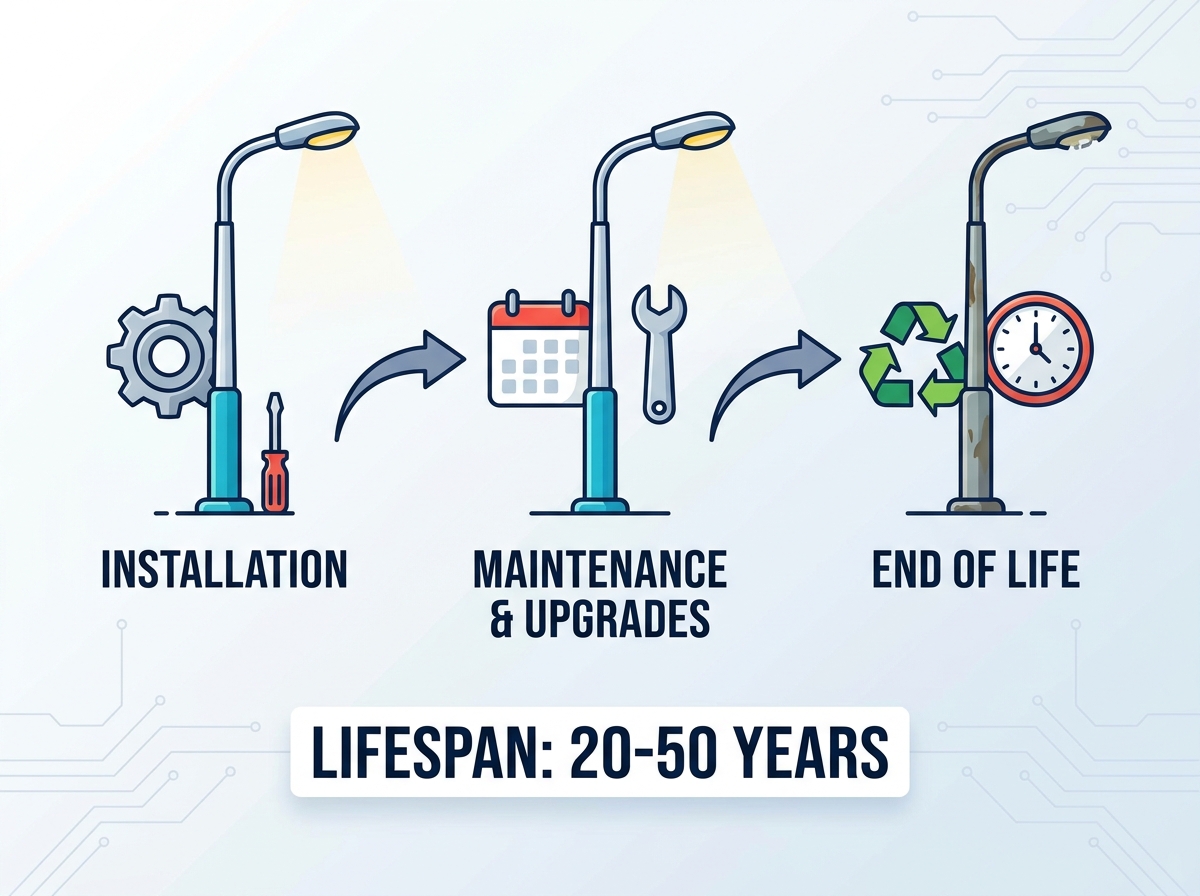
Baseline Expectancy: A properly specified and maintained street light pole typically lasts between 20 and 50 years, heavily dependent on material composition, installation quality, and environmental exposure.
Pole vs. Luminaire: The structural pole outlasts the lighting fixture; while modern LED street lights last 15 to 25 years (50,000–100,000 hours) and legacy HPS lights last merely 24,000 hours, the pole itself must be rated for multi-generational use.
Material Dictates Longevity: Aluminum and fiberglass offer superior corrosion resistance for coastal areas, while galvanized steel and concrete provide maximum structural rigidity for high-wind environments.
Failure Vectors: Improper anchor bolt installation, harmonic vibration, road salt exposure, and compromised protective coatings are the primary drivers of premature pole failure.
Table of Contents
Establishing realistic baseline expectations for infrastructure depreciation requires accurate field data. Planners rely on these numbers for long-term capital expenditure forecasting. The industry standard dictates a 20 to 50-year lifespan for exterior lighting structures. This broad range accounts for varying material grades and environmental conditions across different geographic regions. Engineers calculate this baseline using specific assumptions about the installation environment. When these baseline conditions degrade, the expected lifespan drops proportionally.
We base the 50-year maximum lifespan on several strict environmental and operational assumptions. If your installation site fails to meet these criteria, you must adjust your longevity expectations downward.
Standard soil resistivity levels with neutral pH balances to prevent rapid underground galvanic corrosion.
Consistent preventative maintenance schedules, including visual inspections and base clearing every three years.
Proper initial installation utilizing correct leveling nuts, dry-pack grout, and adequate base drainage.
The absence of catastrophic weather events, such as Category 5 hurricanes or severe seismic activity.
Proper handling during transit and erection to preserve factory-applied protective coatings.
You must distinguish the physical support structure from the luminaire. The physical shaft and base assembly are designed for multi-generational use. The light fixture itself operates on a much shorter replacement cycle. Modern LED fixtures operate efficiently for 50,000 to 100,000 hours. This translates to roughly 15 to 25 years of nightly operation. Legacy High-Pressure Sodium (HPS) fixtures burn out after approximately 24,000 hours. A 50-year structural lifespan supports multiple luminaire upgrade cycles without requiring full structural replacement.
Replacing an entire assembly just to upgrade a light fixture wastes resources and labor. A robust foundation allows crews to simply swap the luminaire head from a bucket truck. This approach minimizes labor hours and eliminates heavy equipment deployment. It also reduces traffic disruptions during routine maintenance operations. The structural support must possess the durability to outlast three or four generations of lighting technology. Achieving this requires precise material selection during the initial engineering phase.
Material selection serves as the primary predictor of structural longevity. Each material offers distinct advantages and specific vulnerabilities based on its chemical and physical properties. Engineers must match the material to the exact demands of the installation site.
Material Type | Expected Lifespan | Ideal Environment | Primary Vulnerability |
|---|---|---|---|
Galvanized Steel | 30–50 Years | High-wind areas, heavy load applications | Rust if zinc coating is compromised |
Aluminum | 50+ Years | Coastal areas, corrosive environments | Lower maximum wind load capacity |
Prestressed Concrete | 50+ Years | Wet climates, areas requiring zero maintenance | Heavy installation weight, concrete spalling |
Fiberglass / Composite | 20–40 Years | High-salinity zones, chemical exposure areas | UV degradation (fiber blooming) |
Galvanized steel remains the dominant choice for municipal lighting and highway infrastructure. It offers exceptional tensile strength and high rigidity. This makes it ideal for supporting heavy fixtures in high-wind zones. Manufacturers protect the raw steel through hot-dip galvanization. This process submerges the steel in molten zinc at temperatures exceeding 800 degrees Fahrenheit. The zinc forms a metallurgical bond with the steel substrate. It acts as a sacrificial anode, preventing rust formation even if the surface is slightly scratched.
Steel remains highly vulnerable if this coating fails over a large area. Deep gouges during transit or installation expose the raw steel core. Once exposed, oxidation begins immediately. Moisture and oxygen react with the iron to form iron oxide. This rust expands, flaking away and exposing deeper layers of the structural wall. Without remediation, the structural wall thickness diminishes rapidly. Regular inspections must verify the integrity of the zinc coating, especially near the base plate where moisture accumulates.
Aluminum provides natural, built-in corrosion resistance. When exposed to air, aluminum immediately forms a microscopic aluminum oxide layer. This hard layer seals the underlying metal against further environmental degradation. Aluminum structures easily exceed a 50-year lifespan in most environments without needing paint or galvanization. They are particularly effective in coastal regions. Airborne salt quickly destroys standard steel, but aluminum remains largely unaffected by chloride ion attack.
The material is significantly lighter than steel or concrete. This reduces shipping burdens and simplifies the installation process. Crews can often erect aluminum structures using light-duty equipment rather than massive cranes. The primary trade-off involves structural rigidity and fatigue resistance. Aluminum bends more easily than steel under extreme stress. Engineers must specify thicker walls or larger shaft diameters to achieve equivalent wind load ratings. Aluminum is also more susceptible to harmonic vibration fatigue if dampeners are not installed.
Prestressed concrete offers extreme durability and requires virtually zero routine maintenance. Manufacturers spin the concrete in centrifugal molds at high speeds. This creates a dense, hollow structure that repels water penetration. High-tensile steel cables run vertically through the concrete. These cables are tensioned before the concrete cures. This prestressing technique gives the rigid concrete remarkable flexibility and bending strength. Concrete structures carry zero risk of rust, rot, or insect damage.
They easily survive decades in damp, challenging environments like swamps or heavy rainfall zones. However, they carry significant logistical drawbacks. Concrete is exceptionally heavy. Transportation requires specialized flatbed trailers and careful route planning. Installation demands heavy-duty cranes and large rigging crews. Over decades, concrete can suffer from spalling. Moisture eventually penetrates microscopic surface cracks, reaching the internal steel cables. If the cables rust, they expand and crack the surrounding concrete, leading to structural failure.
Fiberglass and composite materials offer unique specialized benefits for niche applications. They are entirely non-conductive, enhancing electrical safety in pedestrian-heavy areas. They resist salt, harsh chemicals, and extreme moisture perfectly. This makes them ideal for coastal boardwalks, water treatment facilities, or industrial chemical plants. Manufacturers use pultrusion or filament winding processes to create them. They are lightweight, easy to handle, and require minimal equipment to stand up.
Their primary vulnerability is ultraviolet (UV) degradation. Prolonged exposure to intense sunlight breaks down the surface resins over time. This leads to a phenomenon called fiber blooming. The internal glass fibers become exposed, turning brittle and chalky. Manufacturers combat this by applying UV-resistant polyurethane coatings at the factory. Even with advanced coatings, their rigidity in extreme wind falls short of steel. They tend to deflect and sway significantly under heavy wind loads.
Matching specifications to localized environmental stressors prevents premature degradation. A structure designed for an arid desert will fail quickly in a coastal zone. You must evaluate the specific environmental dimensions of the installation site. This ensures the chosen material can withstand local conditions for decades without requiring constant repair.
Coastal environments present severe challenges for exterior infrastructure. Airborne chloride ions are highly aggressive. They settle on metal surfaces and accelerate the electrochemical corrosion process. Standard galvanized steel degrades rapidly in these zones. The salt strips away the protective zinc layer much faster than normal weathering. Once the zinc is gone, the steel core rusts aggressively, often failing within 10 to 15 years.
For coastal installations, you must specify aluminum or fiberglass. If steel is absolutely necessary for wind load reasons, it requires enhanced protection. Engineers specify marine-grade epoxy coatings applied over the hot-dip galvanization. This duplex system provides a secondary barrier against chloride attack. Regular pressure washing to remove salt accumulation also extends the lifespan of coastal infrastructure.
Winter climates introduce a destructive combination of physical and chemical stressors. Freeze-thaw cycles wreak havoc on concrete shafts and base foundations. Water enters microscopic cracks during the day. At night, the water freezes and expands by about 9%. This expansion widens the cracks, leading to structural spalling. Heavy snow accumulation also adds significant dead weight to the luminaire arms, increasing the bending moment on the shaft.
Road salt represents the greatest threat in winter climates. Snowplows splash de-icing chemicals directly onto the base of the structure. This concentrated saline solution sits on the base plate and anchor bolts for months. It aggressively attacks the steel components. You must specify elevated concrete foundations to keep the base plate above the splash zone. Applying heavy-duty bituminous coatings to the base plate and anchor bolts further prevents chemical degradation.
Sustained high winds and sudden gusts induce severe metal fatigue. Every structure has a specific wind load capacity. This is calculated using the Effective Projected Area (EPA). The EPA measures the surface area of the luminaire, brackets, and mounting arms exposed to the wind. You must match the structure's EPA rating with the exact weight and size of the attached fixtures.
Exceeding the EPA rating causes excessive swaying. This swaying stresses the base welds and anchor bolts. Over time, this repeated stress causes microscopic fractures in the metal. These fractures eventually propagate, leading to catastrophic structural failure. Always calculate the maximum local wind speeds, including hurricane or tornado risks, when specifying EPA requirements. Factor in a 20% overhead buffer for safety.
Underground conditions directly impact the foundation and anchor bolts. Soil acidity and moisture retention dictate the rate of underground corrosion. Highly acidic soils rapidly degrade direct-burial steel or concrete foundations. You must conduct soil resistivity testing before installation. This determines if specialized underground coatings, heavy plastic sleeves, or cathodic protection systems are necessary.
Seismic activity requires specialized engineering. Ground shifts place immense shear stress on anchor bolts. In earthquake-prone zones, foundations must be deeper and wider. Anchor bolts require higher tensile strength and specific elongation properties. This allows the structure to flex during a seismic event without snapping at the base. Engineers often specify larger base plates with thicker gussets to distribute seismic loads evenly.
Even the highest-quality materials fail if installed incorrectly. Implementation risks account for a massive percentage of early structural failures. You must identify these root causes and engineer them out during the procurement and installation phases. Strict oversight during erection is mandatory to ensure longevity.
The base plate and anchor bolt assembly represent the most common failure point. Improper leveling during installation creates uneven stress distribution across the bolts. If leveling nuts are over-tightened or under-tightened, the structure becomes unstable. Inadequate grout application beneath the base plate is a critical error. Installers must use dry-pack grout to provide solid support without trapping moisture.
Poor drainage at the base plate traps water against the anchor bolts. This trapped moisture accelerates corrosion exponentially. Installers must ensure weep holes remain clear of debris and excess grout. If water pools inside the base cover, the anchor bolts will rust through in a fraction of their intended lifespan. Routine inspections must verify that base plates remain dry and well-ventilated.
Wind-induced vibration, known as Aeolian vibration, destroys structures silently. Steady, low-velocity winds create alternating vortices as they pass around the cylindrical shaft. These vortices cause the structure to vibrate at its natural resonant frequency. This high-frequency, low-amplitude vibration is often invisible to the naked eye from the ground.
Over months and years, this vibration causes microscopic stress fractures. These fractures typically form at the base welds or around handhole openings where the metal is thinnest. Once a crack forms, it spreads rapidly under normal wind loads. To mitigate this, engineers install internal vibration dampeners. These devices disrupt the resonant frequency, absorbing the kinetic energy and protecting the welds from fatigue.
Protective coatings are only effective if they remain completely intact. Surface damage during transit is a major implementation risk. Chains, forklift tines, and rough handling easily scratch galvanization or powder coats. Installers often ignore these scratches during erection to save time. This negligence exposes raw steel to the elements immediately.
Contractors must inspect every unit upon delivery. Rigging crews should use nylon slings instead of steel chains to prevent surface gouging. Any damage to the protective coating requires immediate field remediation. Crews must apply zinc-rich cold galvanizing compounds to any scratches before raising the structure. Failing to touch up these minor blemishes bypasses the intended 50-year lifespan, leading to visible rust within the first year.
Achieving the maximum 50-year lifespan requires proactive management. You must balance upfront capital expenditure against long-term operational requirements. Ignoring infrastructure after installation guarantees premature failure. A systematic approach to upkeep preserves structural integrity and ensures public safety.
Consistent maintenance acts as a direct lifespan multiplier. You must establish a strict preventative maintenance schedule. This includes detailed visual inspections every three to five years. Inspectors must look for early signs of rust bleeding, particularly around base welds and handholes. They must clear dirt, landscaping debris, and animal nests from base covers. Debris traps moisture against the base plate, accelerating corrosion.
Crews must also check anchor nuts for proper torque. Vibrations from wind and heavy traffic can loosen these nuts over time. A loose base accelerates metal fatigue and increases the risk of collapse. Repainting or applying fresh protective coatings every decade significantly extends the functional life of steel units. Field crews should wire-brush surface rust and apply marine-grade epoxy to vulnerable areas.
Visual inspections cannot detect internal degradation. You must utilize advanced structural testing protocols for aging infrastructure. Ultrasonic testing measures the exact thickness of the structural wall. Technicians use pulse-echo devices to send sound waves through the metal. This identifies internal corrosion or thinning before catastrophic failure occurs.
Magnetic particle inspection detects invisible surface cracks around critical welds. Technicians apply a magnetic field and iron particles to the weld area. The particles cluster around microscopic fractures, revealing hidden fatigue. Implementing these non-destructive testing methods allows managers to replace dangerous units before they fall into roadways or pedestrian paths.
Managers need technical criteria for deciding when to remediate versus when to replace. You cannot repair a structure that has lost significant structural integrity. The industry standard utilizes a 10% wall thickness loss rule. If ultrasonic testing reveals the wall thickness has degraded by more than 10% from its original specification, replacement is mandatory.
Minor surface rust or localized base corrosion can often be repaired. Crews can apply field-applied coatings to halt surface oxidation. Specialized base reinforcements or steel sleeves can strengthen a weakened base. However, if anchor bolts show severe pitting or if the main shaft exhibits deep stress fractures, remediation is no longer viable. Full replacement becomes a safety imperative.
Modern infrastructure must accommodate evolving technology. The structural lifespan must support future attachments without requiring early replacement. Municipalities are rapidly deploying 5G nodes, environmental sensors, and security cameras. These devices add significant dead weight and drastically increase the Effective Projected Area (EPA).
You must future-proof new installations by over-specifying the initial structural capacity. Select units with higher wind load ratings, thicker walls, and larger base plates than currently required. This ensures the structure can handle the added stress of smart city integration ten years down the line. Failing to plan for these attachments forces premature replacements when new technology rolls out.
The life expectancy of exterior lighting infrastructure is not a static guarantee. It is a direct result of pairing the correct material with specific environmental conditions. It also relies heavily on maintaining high installation quality and rigorous inspection schedules. By understanding the failure vectors, you can dramatically extend the operational lifespan of your infrastructure.
Established in 1994, Dison Group manufactures street lights, solar street lights, light poles, and related outdoor lighting systems. Its experience in light pole production, quality control, and project implementation can help buyers select appropriate materials, structural specifications, surface treatments, and lighting configurations for different environmental conditions.
Audit your existing lighting infrastructure immediately for signs of base corrosion, missing base covers, or metal fatigue around welds.
Verify that the EPA rating of your current structures exceeds the requirements of any newly attached LED fixtures or smart city sensors.
Implement a standardized ultrasonic testing protocol for all steel units older than 15 years to measure internal wall thickness.
Consult with a structural engineer to define exact material specifications and protective coatings for your specific climate zone before the next procurement cycle.
A: Modern LED fixtures typically last 15 to 25 years, operating efficiently for 50,000 to 100,000 hours. The supporting structure is designed to last 20 to 50 years. Therefore, a single well-maintained support structure will outlast two to three generations of LED luminaire replacements.
A: Prestressed concrete and aluminum are generally the most durable, often exceeding 50 years of service. Concrete is impervious to rust and rot, while aluminum naturally resists corrosion. However, galvanized steel remains highly durable and is preferred for its superior strength in high-wind environments.
A: Snowy climates introduce freeze-thaw cycles that crack concrete and weaken joints. Road salt is highly corrosive. When snowplows splash de-icing chemicals onto the base plate, it aggressively attacks the anchor bolts and steel base, rapidly accelerating rust and structural degradation.
A: High winds induce swaying and vibration, causing severe metal fatigue over time. If the structure's Effective Projected Area (EPA) rating is lower than the attached fixture's requirements, the excessive stress will cause microscopic fractures in the base welds, eventually leading to catastrophic failure.
A: Minor surface rust can be remediated by wire brushing and applying zinc-rich protective coatings. However, if ultrasonic testing reveals more than a 10% loss in structural wall thickness, or if deep stress fractures are present, the unit cannot be safely repaired and must be replaced.
A: Consistent maintenance includes visual inspections every three years, clearing debris from base covers to prevent moisture trapping, checking anchor nuts for proper torque, and touching up scratched protective coatings with cold galvanizing compounds to prevent rust.
A: Base failures usually result from trapped moisture and corrosive chemical accumulation. Poor drainage, inadequate grout, or debris inside the base cover keeps water constantly against the anchor bolts and base plate. This localized moisture accelerates rust, destroying the foundation long before the main shaft degrades.